Extroverts are like cold-blooded animals. Cold-blooded animals can generate no body heat of their own; they must bake themselves in the sun to keep from freezing. Likewise, extroverted people cannot generate their own “heat”. Only by basking in the energy of someone else can they survive emotionally.
.
Introverts are warm-blooded. Our fire comes from within.
I look at a picture of Tom when he was young, and Vera when she was young.
I look at a picture of myself.
I think how I look a little like him, a little like her, and a little like myself.
I think how I’m probably a little like him, and a little like her, and a little like myself.
I picture the three of us together.
I picture people seeing the three of us together.
I picture them seeing us and thinking, that’s Tom and Vera, and their daughter.
I think of it registering, and making sense, and people nodding and moving on.
.
Think about having a pain, or an itch, or an anxiety.
Think about having had it so long, and it being so low-level, that you don’t think about it anymore.
Now imagine taking a drug, or getting a warm bath, or a professional massage, that makes it suddenly go away, for however long, maybe just for a moment.
For however long, this thing lifts that you didn’t even notice anymore.
You feel what it would be like to live without that.
.
That’s the best I can do at describing what it’s all like.
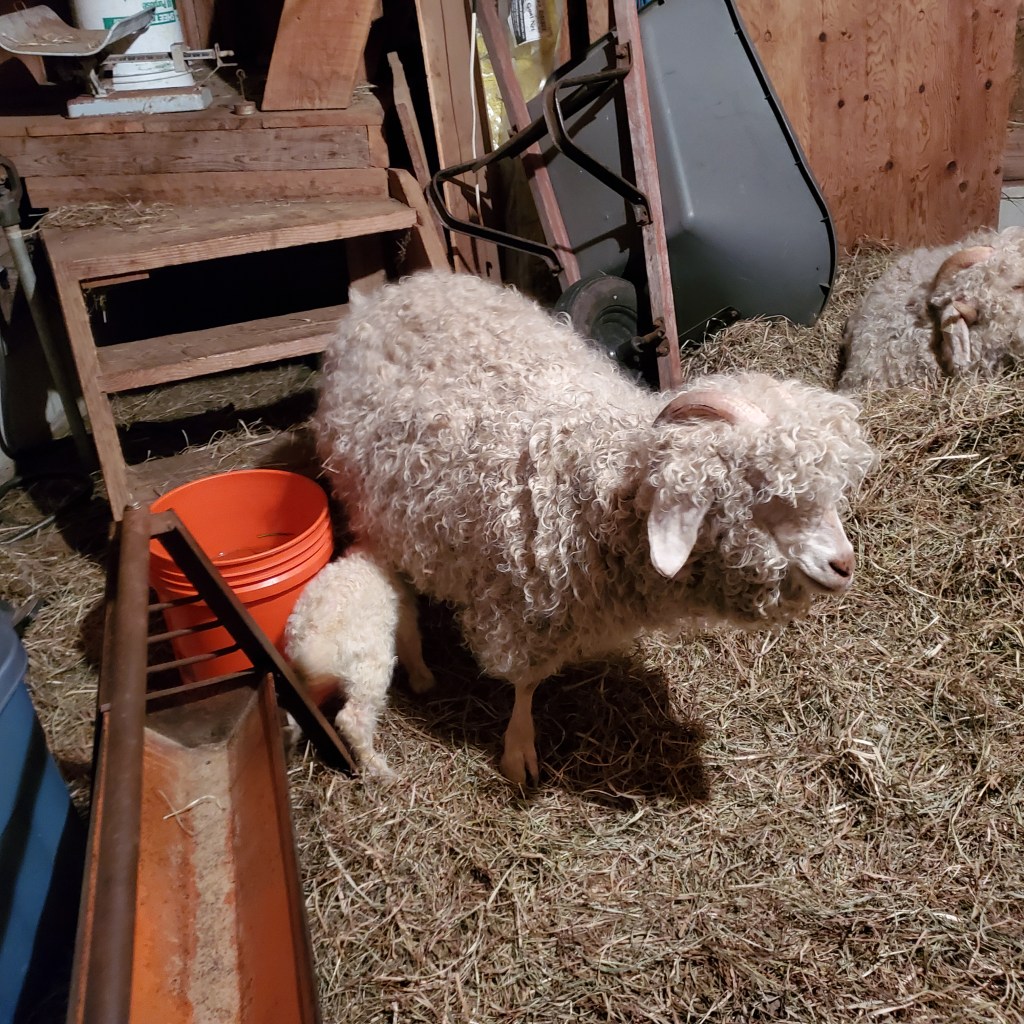
Too cold to hang outside, snow on the compost. Kid not due for another week. No goat chores. But loads of sunshine streaming through the windows. Just me and my toys in my playroom rediscovering all my Stones albums.
Unfortunately X’s appointment is a little behind mine, and he’s looking around May 26. So some of these where I want his company are now dependent on X-Day rather than V-Day.
These dreams are starting to enter the realm of real, actual, honest-to-dog possible occurrences…
V-Day + 1:
Make appointment for haircut & eyebrow wax Plan date for southwestern road trip (dependency: Maggie) Order new carpet
X-Day + 1:
Make reservation for Trattoria d’Elia Make reservation for Single Pebble Plan date for North Carolina (dependency: Xopher)
X-Day + first available weekends:
Go to Montreal. (dependency: border is open) Go to VPB Go to Pizzeria Verita Go to Doc Ponds Go to random restaurant!
July:
Go to Cirque du Soleil (dependency: it still exists)
I have to give a shout-out to this book. I purchased it on a whim at L.L. Bean in Ellsworth, ME on vacation. I’ve since read the entire thing, slowly. What makes this book special is a couple of things:
a) It is not a guide you are meant to flip through when faced with an exotic species of tree. It’s meant to be used the opposite way – read about a tree; then, when you go outside, try to find examples of that tree. Preferably not while driving – I’m afraid this book has semi-permanently altered my road attentiveness for the worse. But that’s my only complaint about it. Also, note that all the trees in the book will be common to our northeasterly region of the U.S.
b) The book has absolutely no dependency on foliage; hence it’s useful year-round. Lord knows foliage can be in short supply for what seems like an endless majority of the time up here in the great often-white north. No, instead the book relies on bark, trunk, twig, & situational identifiers.
You’ll also learn that the most common trees of the region are the red maple, as far as deciduous; and the white pine, among the conifers.
I haven’t fully digested most of the details, yet. But I can now recognize sugar maples and elms by their shapes; and aspens by their two-toned trunks; beeches by their foliage clinginess all winter long; and birches by their peeling bark (though I cannot get the hang of telling apart the yellow, the gray, and the black – only the white birch is obviously what it is).
Also, identify white pines by their groups of 5 needles; red pines have two needles, and pitch pines three. Firs are “flat” and “friendly”… spruces are prickly.
You’ll learn so much! ( )
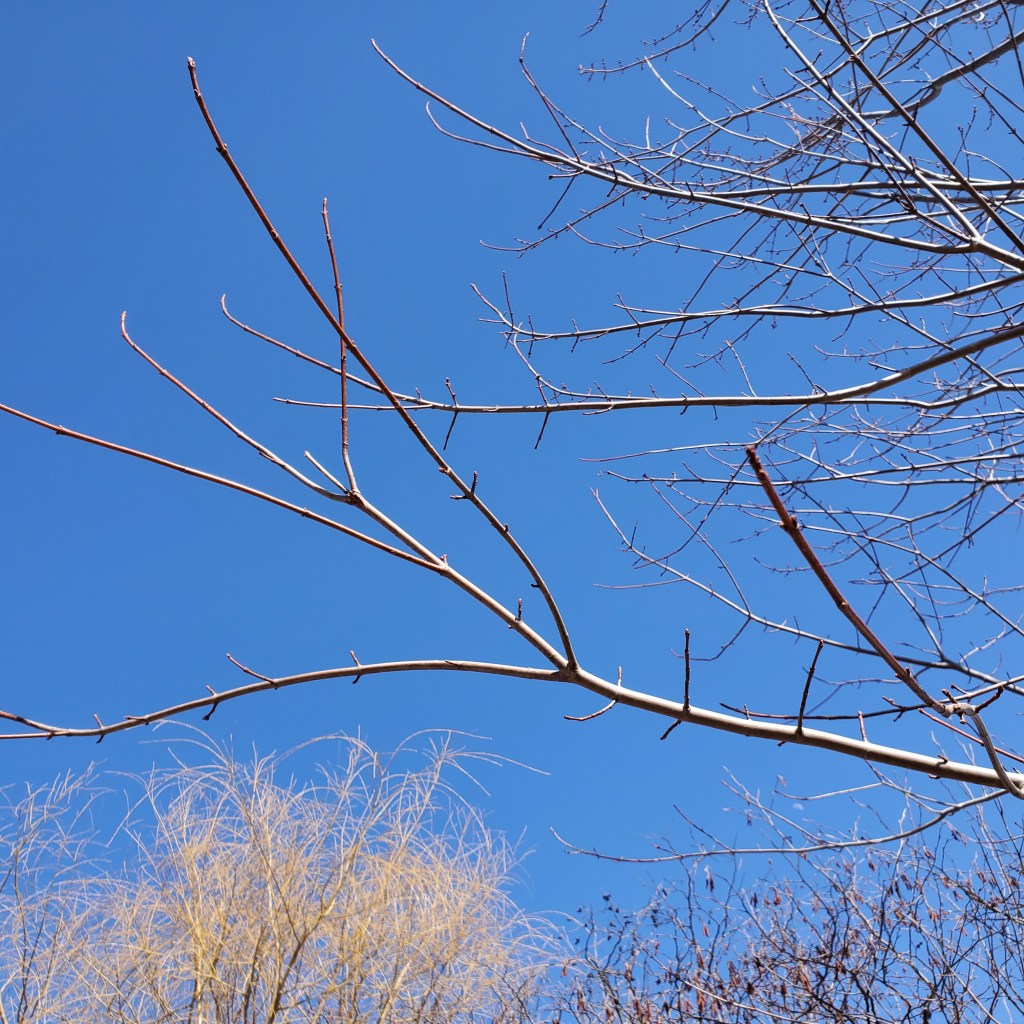
Red maple, the most common deciduous tree of the northeast; recognizable for the redness of its trunk, twigs, and fall foliage. Also, only the maple the ash show opposite rather than alternating branching. See how the twigs on this branch are always paired, directly opposite each other? Most trees will not do this.
I would never have picked this up at all if not for book club. Biographies and histories that are all about great rulers are pretty boring to me. They have nothing to do with anything remotely touching life as I know it. What does it even mean to “amass an army”? As for political stuff – I can’t even stand to read it in the newspaper.
So the writing had to be positively dazzling, considering how interested I ended up being. Cleopatra is a household name to us today due to her sheer charisma. She wasn’t Elizabeth Taylor – she had a hooked nose and prominent chin; and incidentally she wasn’t African, either, but Greek. No beauty or stunning tactician – she ended up losing her kingdom – but no spoilers. I’m serious, I didn’t really know how things ended for her until I read this! I didn’t know much of anything on her at all, obviously.
Of greatest pleasure to read are the more mundane aspects of what life was like in Alexandria (Egypt’s then-capital) in the first few decades B.C. (her lifetime) (yet two more facts I did not know). It was quite a hotbed of feminism. Women enjoyed the right to make their own marriages, to inherit equally, to own property independently, to divorce and be supported after divorce; etc.
And Egypt was of such interest to the Romans because it was swimming in wealth. Golden grain, bananas, apricots, grapes, figs, mulberries, peaches, all were to be had in abundance. Goats were said to bear five kids at a time in Egypt rather than two. Pigeons to produce twelve broods rather than ten. The male skull was stronger near the Nile and rarely went bald. Whites came out whiter, brights came out brighter…
Alexandria itself seems to have been a of marvel – literally a wonder of the world. Its famous lighthouse, half a mile out on a man-made causeway, was the signature of its skyline. One can imagine the visitor first casting eyes upon it, like the skyline of old New York or London, and running out to buy a souvenir lampshade or tile with its likeness. The city was a “sumptuous suffusion of gleaming marble”. We think of ancient times as nasty, brutish, smelly, but I bet Alexandria had it hands down over NYC any day for quality of life. Certainly for quality of figs. ( )







 )
)

 )
) Tytania