Vermont Sheep & Wool 2019

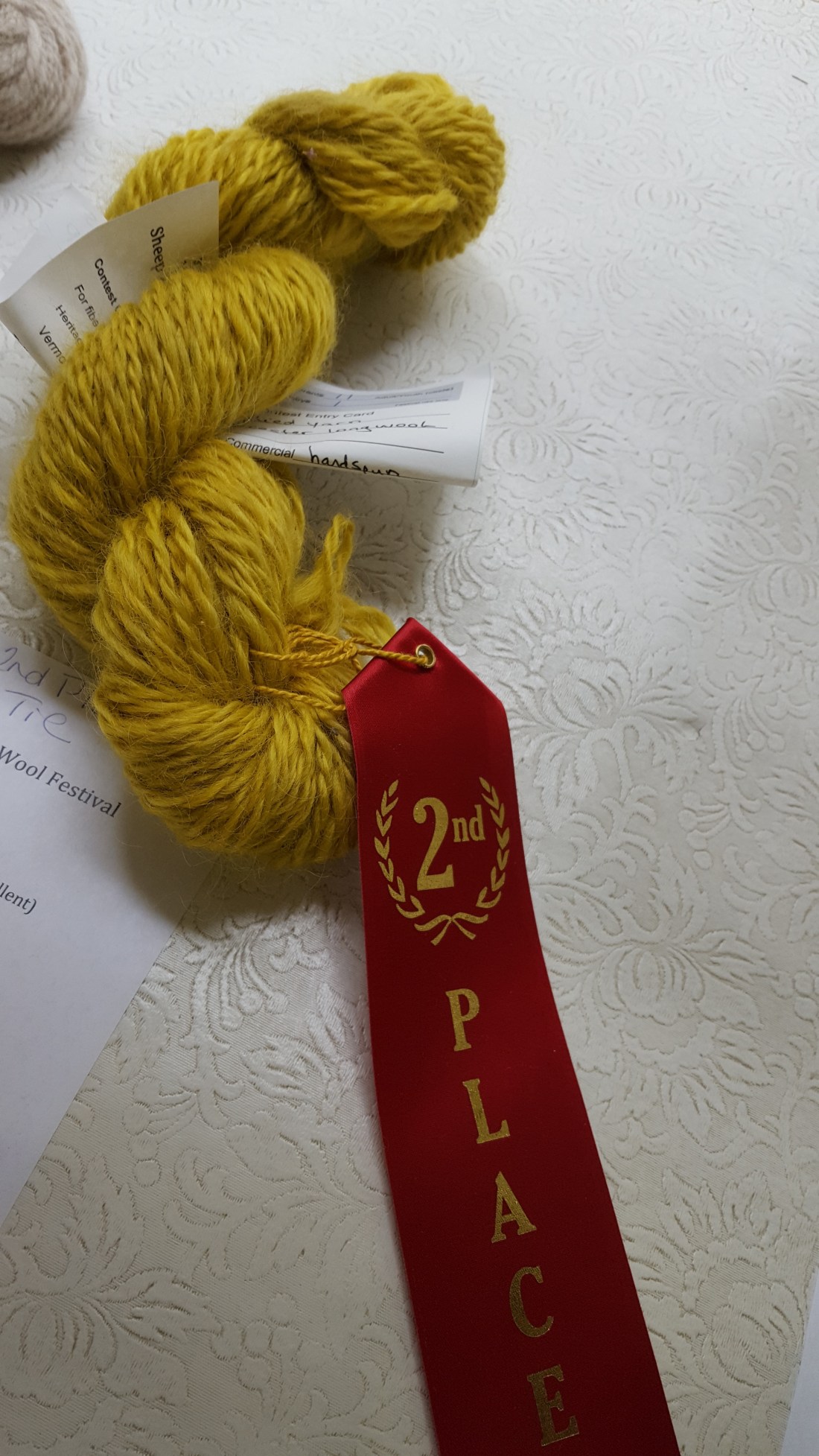
I never posted anything about the Fair.  Let’s talk about the handspun contest.  Since the Fair theme this year was rare breeds, you got extra points for spinning a Shave ’em to Save ’em breed fleece.  Well, I was already doing that!  All I had to do was make sure I conformed to one of their categories.  I chose “medium-weight plied.”
001.jpg

Second place!  OK, it was tied for second.  And there may well have been only four entrants.  But even so, it came in better than third place!  You gotta be in it to win it.

OK, let’s move on to the feedback.  Turns out the judge is the same guy who buys mohair for us from Green Mountain Spinnery.  The comments say, “Color – good!  Tighter ply would be more balanced.”  This is appropriate and unsurprising feedback given my experience, as I never ply, but I dye all the time.

I got 4 points out of 5 for “Aesthetics,” “Originality,” and “Complexity”.  3 points for “Mastery of Craft,” as I suck at plying.  I got 5 points for 100% heritage breed fiber.  And I get a zillion points for participating, because that’s what it’s all about.

Speaking of “it’s participating that counts,” it wasn’t a very profitable year for my booth.  Maybe it’s because the needle felting craze has come and gone.  Maybe my Greener Shades colors weren’t so much eye-candy as my Pro Chem ones used to be.  It wasn’t lack of attendance – the gate keeps increasing every year, they report.  I’ll chalk a bit of the loss up to my location, though.  I am close to but no longer on the end – they put some bunnies there!!  And my space was miniscule.  It was so narrow that once my table was in place, you could only fit one person wide in front of it.  And unfortunately, I made a bad choice of orientation on the first day, having my mohair face away from my own pen.  That meant it was facing the next pen, which was Shetland sheep being peddled by two sweet grandmas (I believe the farm name was “Two Grandmas Farm” or something thereabouts).  Two CHATTY grandmas.  I’ve never seen people so interested in Shetland sheep.  People were constantly in my space to look at the sheep and chat chat chat with the grandmas.  At one point, one of the grandmas herself was not only in my space, but leaning on my merchandise obliviously while she chatted away.

I think this cut down on impulse buys, since nobody could see my full display or comfortably come in half the time.  I remedied the orientation on Sunday, but Saturday is the big day to sell.
 

Book Corner 2019.46

096774136X_01__SX142_SY224_SCLZZZZZZZ_

The Unknown Rockwell by James “Buddy” Edgerton and Nan O’Brien

Interesting as a slice-of-life memoir of a rural Vermont childhood spanning the 30s, 40s, and 50s. I never knew or had much interest in Norman Rockwell, so the links to the famous guy were just part of the picture for me. I had to Google the images of many of the illustrations to which the author referred, not being at all familiar with them – then I discovered that many are included among the photos in the book’s middle.

For background, this is the memoir of someone who grew up next door to the Rockwell family in Arlington, Vermont. It’s written as a recollection in vignettes by “Buddy” Edgerton as an old man, with assistance from a writer. Some of the vignettes were rather dull. “That’s just the way he was” as the tag line, describing Norman, got a little old by the end. Edgerton tries to make you feel that his life really was a Rockwell painting come to life; not just because he, his family, and his neighbors were models for so many pictures, but because life really was like that. I found myself buying it; then I remembered facts like the fact that Buddy, the Boy Scout model for so many illustrations, was never a Boy Scout. What other things are left out of the story, perhaps uncomfortable things? Vermonters don’t talk about uncomfortable things – that was made very clear.

But I love memoirs, and this one will make me look twice next time I see an old Vermonter or read one’s obituary. ( )

Book Corner 2019.45

c1b8c58fabcc1d45930727a5367434f414f4141.jpg

Fatu-Hiva by Thor Heyerdahl

Xopher spotted a copy of this in a used book store, and picked it up upon noticing that it is actually autographed by Thor Heyerdahl himself, 1974! Heyerdahl was the instigator of the famed Kon-Tiki expedition in which he and others successfully navigated a raft from South America to Polynesia, to prove that Polynesia could have been first populated by indigenous Americans.

This book is about events pre-dating Kon-Tiki, when a coming-of-age young Norwegian named Thor decides he’s fed up with civilization – but unlike most teenagers, gathers the wherewithal to do something about it. He convinces his university professors and parents to aid him in a trek to an isolated part of the world where he can live “in nature” in as primitive conditions as possible. Against all odds, he also manages to find a girlfriend eager to go with him! Thus after completing their university studies, newlyweds Thor and Liv set out for the tiny spot on the map which they decided was destined to become their own island paradise; that spot was Fatu-Hiva, an island in the French Marquesas group.

And the craziest thing is, they do find their paradise; it’s just not a permanent situation. They are troubled by mud, mosquitoes, tropical diseases, and other people. But through it all were blissful days upon days where they traipsed through their longed-for garden of Eden.

They seem to find an extended period of peace and nirvana on the far side of the island, living alongside a longtime hermit and his pre-teen adopted daughter, far away from the other islanders, by the shore where the mosquitoes are few. The idyll is eventually destroyed, however… no spoilers, but it seems hell is indeed other people. That, and demon drink.

There are many pages where Thor just goes on about the beauty of nature around them, which can get a bit monotonous. His philosophy tends towards the simplistic – civilization bad, white man bad, state of nature perfect, etc. – especially towards the beginning of the story; and he tries to bend all his observations to his philosophy – diseases come from the white man, diseases would never happen when living correctly in a ‘state of nature’, for example. He seems to mature a bit over his long year on the island, however.

There is little to no sidelong mocking of the natives in this book… individuals and behaviors often get his scorn, but each islander is presented as a full human being, never a caricature. Indeed, Thor conveys his growing realization during the year that the islanders are people exactly like us, with every bit as much intelligence; he observes that we tend to think of illiterate people as childlike, which is a gross injustice and blindness. We are all human beings, doing everything we can put our minds to, given the resources before us.

But while it seemed to me that Thor was generally refreshingly respectful and equitable in his treatment of his fellow islanders, there was one exception where his behavior left me flabbergasted. He and Liv begin a collection of human skulls which they take from areas considered “tabu” by the natives. There are photos of Liv grinning happily while surrounded by human skulls. This seemed horribly disrespectful, not to mention ghoulish.

Liv was an absolute saint, by the way. By all accounts, she had all the eagerness for the adventure as did her husband; the book is by and large written in first person plural, not singular. It is Thor and Liv as a unit who discover, learn, enjoy, suffer together.

There are lots of amazing black-and-white photos throughout the book. I was truly astounded by them, for various reasons. a) Some of the photos have both Thor and Liv in them, in some remote situation – who took the picture?! b) How did they manage, through all their soggy trials and travails, to keep their camera and film with them, and dry enough to be functional? c) What faith did it take to keep taking pictures of things, with no ability – I presume! – to develop the film until if and when you or the camera made it back to civilization? I don’t know, maybe there was a Foto-mat in nearby Tahiti where they were sending things.

I found myself thinking at the book’s beginning, as the adventure first gets underway: but what about modern medicine? What about birth control? How will they keep healthy, and is Liv prepared to birth babies without assistance on an island? They never really address the latter, except one passing remark towards the end that Liv might “at any time” by “blessed” with a baby; so apparently no birth control. As for medicine, illnesses and injuries are dealt with as they came, and both heroes lived to tell their tales.

This book really did make me think about nature, civilization, and the commonness of human ingenuity. ( )


Book Corner 2019.44

1588343774_01__SX142_SY224_SCLZZZZZZZ_.jpg

Maine to Greenland  by a couple of dudes

OK, I skimmed some parts. But it’s mostly a photography book and I read all the photo captions. I read the chapters on Maine, Newfoundland, and southern Greenland with particular interest. I was disappointed there was nothing at all on New Brunswick or Nova Scotia – the title led me to believe we’d be visiting all the maritime provinces. I’m just back from Maine and I’ve been to southern Greenland – these pictures actually do it justice, and take me back to all the beautiful sites we visited. Newfoundland has been on my short list, now more than ever after reading about and seeing the pictures here of L’Anse aux Meadows. It’s a big, lovely part of the world, the “Maritime Far Northeast.” Note that you will learn more here than you’ve ever heard in your life about the indigenous people of the Arctic and sub-Arctic – Innuit, Innu, Pre-Dorset, Thule, etc. Climate change also plays a starring role in the text. But the photographs are the stars. ( )


Book Corner 2019.43

0316478520_01__SX142_SY224_SCLZZZZZZZ_

Talking to Strangers by Malcolm (sigh) Gladwell

Malcolm Gladwell’s latest is as much an engrossing page-turner as any. It goes off on many tangents but all are related to the theme of how we “get things wrong,” particularly when judging and trying to interpret strangers. His goal is to try to examine in detail what happened in one particular case of a traffic stop come to a tragic end. Sandra Bland was pulled over for failing to signal; she was rude to the cop; things escalated, and she was jailed. She killed herself in her jail cell.

Gladwell brackets the book with the story of Sandra Bland. Ultimately, he comes to the explanation that the police department in question was applying an aggressive kind of “stop and frisk” as applied to cars that had no place in a low-crime area such as the rural Texas road where Bland was pulled over. Police departments across the country have misinterpreted an approach to preventive crime fighting that was proven effective in extremely targeted high-crime areas, and are applying it globally.

So, the results of a study are misinterpreted. This puts two strangers in a confrontational situation they should not be in. And they get it tragically wrong.

Thus, a book about the bigger picture of “Talking to Strangers”. There is a chapter about the Penn State child abuse case; and one about college drinking, blacking out, and date rape; and one about the murder case that happened in Italy involving American students. I particularly liked one about how the suicide rate in England plummeted as the nation switched from what they called “town gas,” which will kill you if you stick your head in the oven, to a new formula of natural gas which was not lethal. Turns out (“turns out” – there’s a cliché that that phrase is what all Gladwell books boil down to)… people don’t so much want to kill themselves in general, as to kill themselves in a particular way. Take away that method and… they very well might not. People’s desires are situational. Thus, efforts to put life-saving nets off the Golden Gate Bridge; and, of course, handgun control. Impediments like these, which take away or effectively hinder the possibility of ending one’s life in a particular way, can save lives.

So, um, where were we – that’s right, “Talking to Strangers”! It’s really hard in retrospect for me to remember how all these things tied into that overarching theme. It’s a bit of a stretch, but they do all seem to contribute to the narrative of “things going wrong” in the Sandra Bland case. I didn’t mind the stretch. I love Gladwell’s books and I can’t resist being happily carried along into any tangent he cares to take me to. ( )

Book Corner 2019.42

0316551244_01__SX142_SY224_SCLZZZZZZZ_

Dopesick by Beth Macy

This was a really hard book to get through. There was no narrative arc – even a work of nonfiction should have narrative; but this was just one bad thing after another. I chalked up seeming non-sequiturs to my lack of ability to focus; but by the end I was spotting them for sure. For example, on page 264 there’s a paragraph about how “Female user-dealers are incentivized to lie in their quest for what the government calls substantial assistance,” which comes out of nowhere and goes nowhere. The chapter isn’t about females, it’s about Ronnie Jones.

There are no happy endings here. I get that that’s reality. There’s no cure for addiction, just struggling every day to avoid the likely relapse. The closest we get to any hopeful notes in the book are the nods to medically assisted treatment, or MAT, as the best evidence-based route available to clean and sober living. So OK – couldn’t we read a story about someone holding down a job and family with the help of MAT? Just one little success story, one thread of hope, could make the difference in a reader coming away inspired to act to be supportive of addicts and MAT in their communities, vs. finishing the book horrified and hopeless. ( )

Postscript: Last night my book club met and covered this.  It was the most emotional book club meeting I’ve ever experienced in 20-odd years as a member.  One of our members recently lost her son to opioid addiction.  During the meeting she told his harrowing story.

I’m the club coordinator, and as such I’m the one who digs up possible titles and suggests them to the group.  I had been second-guessing myself for even putting this one out there, in light of the bit I had known about this woman’s experience.  But she had been the first one to vote we do it.  She said it was certainly a painful read for her, and it obviously wasn’t easy to tell the story she did; but her goal in having us discuss it was to help remove the stigma surrounding addiction, to hopefully change people’s way of thinking.

Mission accomplished.  I don’t think I’ll ever look at addiction the same way again.  This is a disease.  It alters the brain.  It needs to be medicated.  Unfortunately it’s an extremely long-term, sometimes lifelong disease.  A little bit of 12-stepping isn’t a cure.


Maine 2019 Day 13: Aurora

218.jpg

Last full day in Maine.  😦  We did the 11-mile Lake Auburn Loop.  Billed as “easy”; but this word “easy,” I do not think it means what they think it means.  I’ve gotten a lot better about hills these days, but I was defeated by one stretch of this loop.  That said, the part by the lake sure is indeed easy and beautiful.

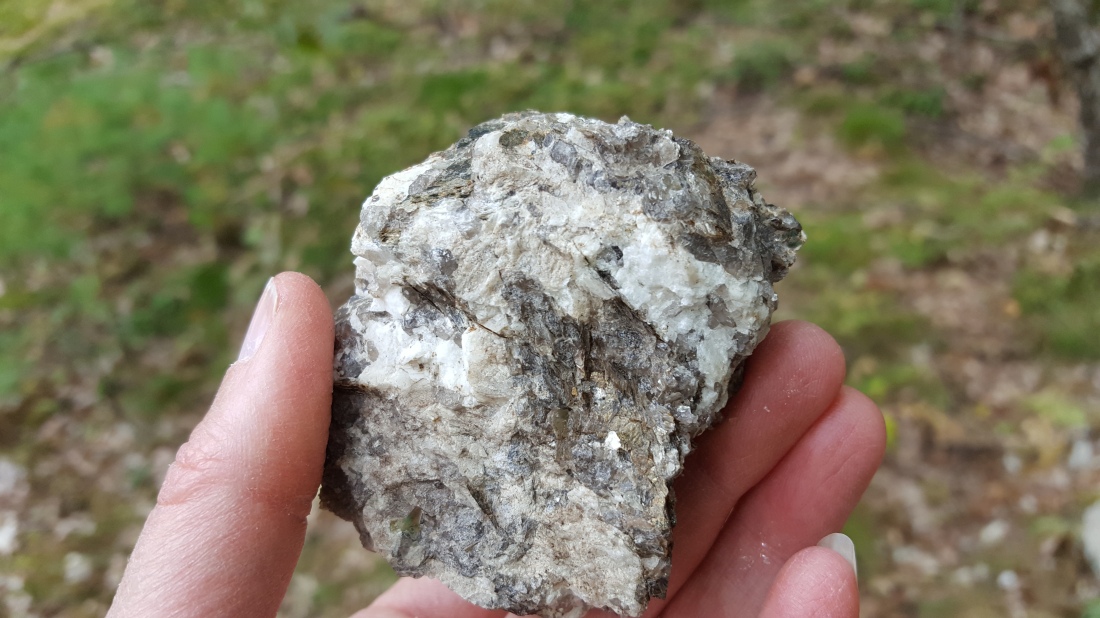
But, hills or not, 11 miles is piffle to us after two weeks of nearly non-stop wrecking our bodies!  So after a light lunch to satisfy our “apatites” we did a little walking and rockhounding in a place called Mount Apatite.  I don’t think X found any apatite, but there was plenty of mica, as shown here.

The final totals are 87 miles biked, 22 brewpubs.

It is super relaxing to spend two whole weeks doing nothing but some of your favorite things.  No flights, no foreign language, no jet lag, no “big sights” to take in.  It’s an immersion in real life.  Two places I was happiest were Bath and Schoodic.  I loved Acadia and Bar Harbor and felt we barely scratched the surface.  X thought we should do lots more taking advantage of that AMAZING bus.  The area has an entirely free bus, with commodious bike racks, that goes all over the park.  You can totally over-exert yourself and just bus your way back home.  Not that we did that.  Well, not more than once.  Twice.  Anyway – I LOVED the Bar Harbor Motel.  I loved their bike storage, their location RIGHT by a bus stop (not that we needed it, well, not more than twice), everything about their service and amenities – I even loved their breakfast, and I HATE hotel breakfasts.  I avoid hotel breakfasts.  Yet I always looked forward to this one.  Plenty of everything, no fighting people, wild Maine blueberries by the bucketful everyday!!  Cereal ALL DAY LONG!

I think we need to go back.  I think next time I would break up the trip by stopping over in Bath.

Maine 2019 Day 12: Augusta & the Kennebec

212.jpg

Kennebec River Rail Trail, Augusta

Day 12 we left Bar Harbor, and rather than schlep all the way home from there, broke up the trip with a couple of nights in the Augusta/Aurora area (say that 10 times fast).

We did a pleasant 12-mile round trip on this lovely, flat, straight rail trail, and spotted a bald eagle.  He’s actually in this picture.  He’s on one of the near islands.

There was a brew spot at the beginning of the trail in Augusta where we had a lovely pizza lunch.  There was another at the end of the trail and another in the middle.  But we didn’t hit the one in the middle, because when we hit the one at the end, it happened.  I reached peak beer.  I looked at my pretzel nuggets and my flight of four, and I said, if I drink any more beer on this trip, I am going to hate beer.  So I stopped.  My passport ended up at 22 – far short of the t-shirt winning 30, but beyond the cap-winning 15… maybe they’ll round up?!  I’ve sent it out and time will tell.

Miles biked: 76

Brews: STOPS at 22.  I know when to say when!


Maine 2019 Day 11: Schoodic Peninsula

188.jpg

Grindstone Point, Winter Harbor, Schoodic Peninsula

Most of the park is on the Mt. Desert Island peninsula; but a little bit is on the Schoodic Peninsula to the east.  It was SO peaceful here.  We did an easy 10-mile loop with a detour to the spot shown above, Grindstone Point.  We had it entirely to ourselves.  We saw loons (pretty sure).  Driving along the peninsula later, we saw dolphins (pretty sure); and so many beautiful, quiet spots.  I loved it here.

Miles biked for the trip up to 64.

We hit a couple of brew spots in Ellsworth that evening; total up to 19.