Good Omens by Terry Pratchett & Nail Gaiman
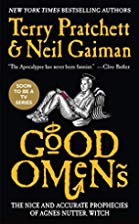
A crazy slouch towards Armageddon. I’d say it was more Pratchett than Gaiman. The jokes just never stop.
It was long and rambly, with a cast of characters to match. There were some I loved every time they appeared (Crowley, Aziraphale, Anathema – her name alone has to make you love her). At the other end were some that I really found repulsive, and disliked whenever they got airtime (Shadwell). I wasn’t crazy about Newt. As for the kids, they were good kid characters, but being American with little exposure to Britain, I just couldn’t reconcile those heavy accents (and ideas) coming out of children’s mouths. E.g., “I don’t see what’s so triffic about creating people as people, and then gettin’ upset ‘cos they act like people…” This is the 11-year-old Antichrist speaking. To me it just sounds like Andy Capp or one of those dimwitted Python characters.
Yes, the Antichrist; so anyway – the purported plot of the book is that the Antichrist comes to earth but gets switched at birth, and grows up without the proper diabolical “training.” So he just turns out to be a boy with a few superpowers, and isn’t really evil at all.
Meanwhile what happened to the baby who got the training? I’m not sure. If he turned up again at all, it was extremely rarely. So I thought this was going to be a big “switched at birth”, “nature vs. nurture” kind of subplot, but it wasn’t so much.
Then there were the Four [Motorcycle] Riders of the apocalypse. I read in the afterward that this was Gaiman’s main contribution. Those portions are a little less jokey, but I don’t know, things just didn’t really come together. Everything was just kind of wacky.
If you like Terry Pratchett, I think you’ll love it. if you’re looking for more Gaiman, I don’t really see it. (A crazy slouch towards Armageddon. I’d say it was more Pratchett than Gaiman. The jokes just never stop.
It was long and rambly, with a cast of characters to match. There were some I loved every time they appeared (Crowley, Aziraphale, Anathema – her name alone has to make you love her). At the other end were some that I really found repulsive, and disliked whenever they got airtime (Shadwell). I wasn’t crazy about Newt. As for the kids, they were good kid characters, but being American with little exposure to Britain, I just couldn’t reconcile those heavy accents (and ideas) coming out of children’s mouths. E.g., “I don’t see what’s so triffic about creating people as people, and then gettin’ upset ‘cos they act like people…” This is the 11-year-old Antichrist speaking. To me it just sounds like Andy Capp or one of those dimwitted Python characters.
Yes, the Antichrist; so anyway – the purported plot of the book is that the Antichrist comes to earth but gets switched at birth, and grows up without the proper diabolical “training.” So he just turns out to be a boy with a few superpowers, and isn’t really evil at all.
Meanwhile what happened to the baby who got the training? I’m not sure. If he turned up again at all, it was extremely rarely. So I thought this was going to be a big “switched at birth”, “nature vs. nurture” kind of subplot, but it wasn’t so much.
Then there were the Four [Motorcycle] Riders of the apocalypse. I read in the afterward that this was Gaiman’s main contribution. Those portions are a little less jokey, but I don’t know, things just didn’t really come together. Everything was just kind of wacky.
If you like Terry Pratchett, I think you’ll love it. if you’re looking for more Gaiman, I don’t really see it. (  1/2 )
1/2 )


 )
)
 )
)

 )
)