Book Corner 2021.58

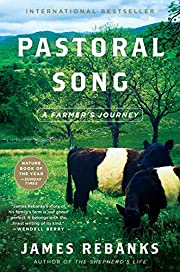
Rebanks’ family have been fell (hill) farmers in Cumbria in the north of England since 1400-something. It’s mind-boggling to think of belonging so truly to a particular spot on earth.

This book is best when he is simply describing his farm, and his grandfather, and his father. The past two generations began to ‘modernize’, ‘get big or get out’, mow down hedgerows, specialize, feed silage rather than hay, and above all apply synthetic fertilizers. These things degrade the land and ultimately the farmers themselves. Rebanks is now trying to rejuvenate his farm by going back to the old ways, and the even older ways of setting nature back to rights in certain areas. He thus has to supplement his reduced farm income by selling books; and I’m only too happy to help him along in the endeavor.

Book Corner 2021.57

by Joseph Henrich

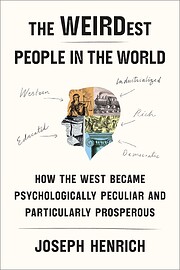
Along the lines of Jared Diamond’s GUNS, GERMS, & STEEL, this is a big-picture book with a big-picture answer to the basic question: Why did and does Europe rock so much?

In one of the final sections he answers Diamond directly: GG&S is a great theory to explain why Europe was so far ahead circa 1000 AD. But then, why England? Why the Netherlands? TWPITW purports to be The Explanation for why Europe continued to rock so much.

To recap Diamond (and GG&S has always been one of my all-time favorites): it’s agriculture. Eurasia got all the good crops and domesticatable mammals. If you’re stuck eating cassava with nothing to pull a plow, why invent the wheel?

And to summarize TWPITW’s 489 pages of content (there’s a couple hundred more pages of appendix & index)… it’s what the Catholic Church (back then simply the Church) did to the family.

I should probably back up: WEIRD people are Western, Educated, Industrialized, Rich, and Democratic. (Just double-checked myself – yup, 5 out of 5.) And we got this way because our psychology was altered when our vast kinship networks were destroyed by what he calls the Church’s MFP – no, not Maximum Fluoride Protection, but Marriage & Family Program. The Church’s rules said: no more marrying your cousin. No more staying within the husband’s or wife’s parents’ house after marriage. No more arranged marriage. No more polygyny, “or even moderate bigamy” as THE KING AND I song goes. No more marrying your former in-laws.

And this was all a tremendous shock, and a heck of a lot of work to get people to go along with – it took centuries for it all to really gain a foothold. And that’s because being proto-WEIRD is truly weird – we, meaning humans, have always lived within vast kinship networks. Marrying cousins or in-laws kept everything in the clan. Polygyny and arranged marriage cemented patriarchal power. Family/clan/tribe has always meant everything it was to be human. Now, disassociated from that source of meaning, protection, and power, individuals had to look elsewhere – to strangers, voluntary organizations, the Church (how convenient) – and within. This made us more trusting of strangers, and more literally self-centered, than we were when were all Family Guys.

It played a lot of other psychological tricks too. 400 pages worth. Yes, this was a difficult book to read, physically – every night was a weight-lifting exercise. In the end I do like the theory; definitely a fascinating way to look at things. But I guess I have two faults to find.

a) It wasn’t the book I thought I was going to read. It starts out with in-depth looks at non-WEIRD societies, and contrasts with our own – but I thought it was going to be mostly, or more of, that. It’s actually a lot more rah-rah cheering for how great us WEIRD societies are, and less about how, well, weird we are.

b) Why exactly did the Church do all this, fight for centuries to come up with weird new rules for who and how and how many to marry? The reasons were “many and varied.” I kid you not. That’s the extent of the explanation.

So just keep in mind, next time you’re reading a blithe statement about human psychology – it may very well apply only to WEIRD human psychology. Things we think of as rational “givens” aren’t givens. The ideals of democracy, human rights, etc. – these are not self-evident, with apologies to Thomas Jefferson. They are ideas cooked up by WEIRD minds.

Great food for thought – WEIRD thought.

Book Corner 2021.56

by Agatha Christie

OMG, click the link under the book image for the Wikipedia entry, if you want to be shocked by this book’s original title. And I thought “Ten Little Indians” was offensive.

ANYWAY.

This was the first Agatha Christie I’ve ever read. I kept thinking, boy, this is cliche; and having to correct myself, NO, this is where the cliches COME from. But I couldn’t help thinking that the butler probably did it.

I thought the ending would be more of a trick.

I do have to admit that although this genre does not interest me much, her building of suspense and character and suspicion was very artful. I guess I see why she is considered a master.

Book Corner 2021.55

Kind of disappointing, because the letters aren’t allowed to stand on their own. Almost every one is introduced with context, often unnecessary; and worse, each one has a cutesy ‘title’ in italics which is a phrase excerpted from the letter. I trained myself quickly to ignore these titles. I’ve always found it annoying to read something in a pull-out, and then read the exact same words again.

The letters span her adult life and are chronological. It is sad to thus ‘watch’ her grow old.

No new revelations here for any serious fan.

Book Corner 2021.53

by John McWhorter

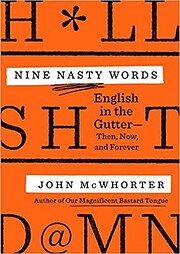
Linguist John McWhorter gives us the derivation and analysis of the usage over the years of nine nasty words. Dirty words, profane words, taboo words.

I love the exploration of how the suffix “-ass” is evolving into a mere adjective identifier. McWhorter shows this in chart form (his charts are funny): In 1830, a “big-ass man” would be a man with a big ass. Starting around 1930, a “big-ass man” would be a man who was surprisingly big. In 2300, it’ll just mean a big man. Apparently the pidgin that is the official language of Papua New Guinea treats “-fella”, which for them morphed into “-pela”, in the same way. A big guy is a “bigpela” guy, etc.

McWhorter is my age and I also like his usage of shows like THE JEFFERSONS to illustrate points.

And for the first time I’ve seen in print, someone comments on that extremely annoying “young female” accent that drives me up a wall, where short -e is pronounced like a short -a. I.e. instead of “My Mom is dead,” it comes out “My Mom is Dad” (I’m taking that example from a filthy old Daniel Tosh clip). Uuuuuuuugh, I hate this so much! As a linguist, though, McWhorter isn’t judgy about these things.

Book Corner 2021.52

by Woody Allen

Am I a bad person because when I saw Woody Allen had a memoir I immediately wanted to read it? Am I a bad person because I thought it was funny and I enjoyed reading it? Am I a bad person for finding his account of the whole molestation mishigoss is credible? No! I’m a bad person for other reasons, not these.

He’s funniest talking about his early life. Once his career takes off it seemed to get more matter-of-fact; once we are in his late career, the movie titles flying around and actors and actresses who were all wonderful, drop-dead sexy, beautiful, amazing, a joy to work with, etc. etc. and all the other famous people he’s met and known, well, it makes your head swirl a little.

So it wasn’t wall-to-wall comedy, but it was enough to be worthwhile and remind me why I’m a fan.

Incidentally, my favorite of his movies in order are:

  1. Annie Hall
  2. Manhattan
  3. Stardust Memories
  4. Love & Death

Yeah, really going out on a limb there, I realize.

And incidentally if you want to read something supportive of Mr. Allen, this statement by his adopted son Moses may be the best.

Book Corner 2021.50

by Sebastian Junger

The author treks west across Pennsylvania with a group of other former combat veterans, following railroad tracks, secretly camping wherever looks safe, and eating big diner breakfasts and dinners. Why? Not clear. We find out way near the end that Junger is going through a divorce, which may be relevant.

I did not realize that it is illegal to walk along railroad tracks, thus “trespassing on railroad property.” I certainly didn’t realize that it’s as illegal as it is in this book. The group of hikers is constantly dodging into the woods, wondering if distant sirens are for them, wondering if someone who said hi is going to turn them in.

But precious little of the book is about hiking, camping, roughing it right in the middle of civilization, or our narrator’s journey. It’s digression, digression, digression. Ireland, Native Americans, Eurasian nomads. The overarching theme is not freedom, but fighting. All the digressions were about warriors, basically. Not interesting to me. Not the book I thought I was going to read.

Book Corner 2021.48

by Oliver Burkeman

Can I say that this may be the best book I’ve ever read, and still be taken seriously? Burkeman just nails it. And can I say that by “it,” I mean “what it means to be human,” without totally losing you? What it means to have human neuroses – what if I put it that way? To always be looking toward the future. To always be failing when we deliberately try to be in the moment. To always feel too “busy.” To always be thinking that somehow, someday, we’ll get on top of everything, stop having problems, live in nirvana.

I’m not sure I can really do justice to this book in a review I write in one sitting; I have a feeling I’m going to be revisiting it many times, always finding more and more I feel compelled to share.

And an amazing thing about this book is that I feel it helps me understand my husband better. I feel that if I forced him to sit down and read this book, his reaction – after boiling with frustration that I was keeping him away from his internet memes – would be “Well, yeah.” The stuff that Burkeman “gets”, Xopher already “gets,” and somehow has managed to “get” for all these years I’ve known him. Now maybe I’m starting to “get” it too.

a) Xopher refuses to engage in plans for the future. I mean, yeah, he did call to try to order hay a few days (but only a few days) ahead of the weekend we hoped to put it up for the winter. When holidays are rolling around, yeah, he will make plane reservations to see his folks. But those are aberrations. In general he won’t plan a thing he doesn’t absolutely have to. More frustration for me, I cannot engage him in discussing any plan more than 24 hours away. He will simply sit there in a non-plussed attitude (even more than usual), and if he offers anything, it will be a reminder that “We don’t know what the weather might be” or something like that. What frustrates me is my resulting daydreams about “normal” couples – couples who, over dinner or washing the dishes, might idly chat about, oh, I don’t know, what they might do over the coming weekend, or places they might like to go on vacation next year. Nope, not happening.

I have pressed him about this, and he once offered this explanation: “Anything good that ever happened in my life happened without me planning it.” Yeah, I grumbled, probably because *I* planned it.

But seriously. Burkeman is on Team Xopher: “Whatever you value most about your life can always be traced back to some jumble of chance occurrences you couldn’t possibly have planned for.” Burkeman says that the planners are trying to exert control over the future, an impossible task. The future is just not something you can order around that way. It can’t be done, and only makes you anxious.

b) Xopher has always admired people who undertake big, grand, thoroughly pointless projects. Huge works of art or devices that serve no purpose. I thought he was just admiring people who had drive and ambition to do something big, when he can’t even get himself to put the finished trim around the bathroom window we installed back in 2004. But maybe it’s that he gets the value of pursuing “atelic” activities – those done for their own sake, with no goal. “Hobbies,” we used to call them, though a wonderful little sub-chapter expounds upon how we now find that word a little embarrassing. “In an age of instrumentalization, the hobbyist is a subversive: he insists that some things are worth doing for themselves alone, despite offering no payoffs of productivity or profit.” And this also helps explain why so many people take to etsy – makes their hobbies seem less embarrassing if they can be reframed as a “side hustle,” pursued for profit. And I love the celebration of hobbies as being, by design, something we are often not particularly good at. If you pursue something while being utterly crappy at it, that really proves its uselessness and hence your true love for the pursuit. OK, I just like consolation that it’s OK that I suck at so many of the things I do.

c) Xopher exudes cynicism, depression, and downright being a downer. It’s true that Xopher does actually suffer from official depression; but sometimes he is such a cynic and downer it takes me aback. Well, apparently, there is a relief in giving up hope. “Seeing that things aren’t going to be okay. Indeed – they’re already not okay.” The result is apparently not despair. The words Burkeman uses are relief, motivation, possible, joyful. Maybe I’ll get there.

Or not! But there will be more and more quotes and concepts to share in the days ahead.