

Author: christinestaffa
My life's journey has taken me from the streets of New York, up the Hudson Valley, to a little goat farm under Vermont's highest mountain.
Mudroom Exterior Painting

I thought it looked kind of nice the way it was (grayish color on the left is what’s undone)… but getting it painted in “Yukon Sky” to match the house makes a big difference! Soon the addition will appear seamless.
Thoughts About Parallel Lives & Second-Guessing
Second-guessing and doubt and guilt arise when you think, “I shoulda” or “I shouldn’ta”.
Shoulda shoulda shoulda…
Shoulda done this instead of that.
Shoulda gone somewhere else.
Shoulda stayed home.
Shoulda done something productive.
But if you think of the gazillion parallel lives that branch out from every moment… your path forward is like a set of dominoes falling straight ahead. But from either side of you, at every moment, you flip another domino, and another series of dominoes falls off to the side.
Surely of those gazillion parallel lives, some would be better, by any objective criteria, than the one you’re in. Some would be worse.
What sense does it make to regret even one of those gazillion paths not taken? When there are simultaneously a gazillion better paths and a gazillion worse paths? A true infinity of a variety of paths.
Book Corner 2019.25

Born a Crime by Trevor Noah


Noah is a comedian, and sometimes drops a one-liner or story that’s a little jokey, or even very jokey. I thought the story about Hitler was LOL. But it’s not a comic book.
Noah is not a writer, so it’s not a literary, gripping, flowing book.
Noah is not THE GLASS CASTLE, so it’s not “OMG how I survived my crazy childhood”. There is racism and domestic abuse out the wazoo and worm-eating poverty. But it’s not a shock book.
Ultimately it is a story: the story of his mother. Noah knows what material he’s got, and that his mother’s story is the Big Story in his life, and he tells it simply and effectively.
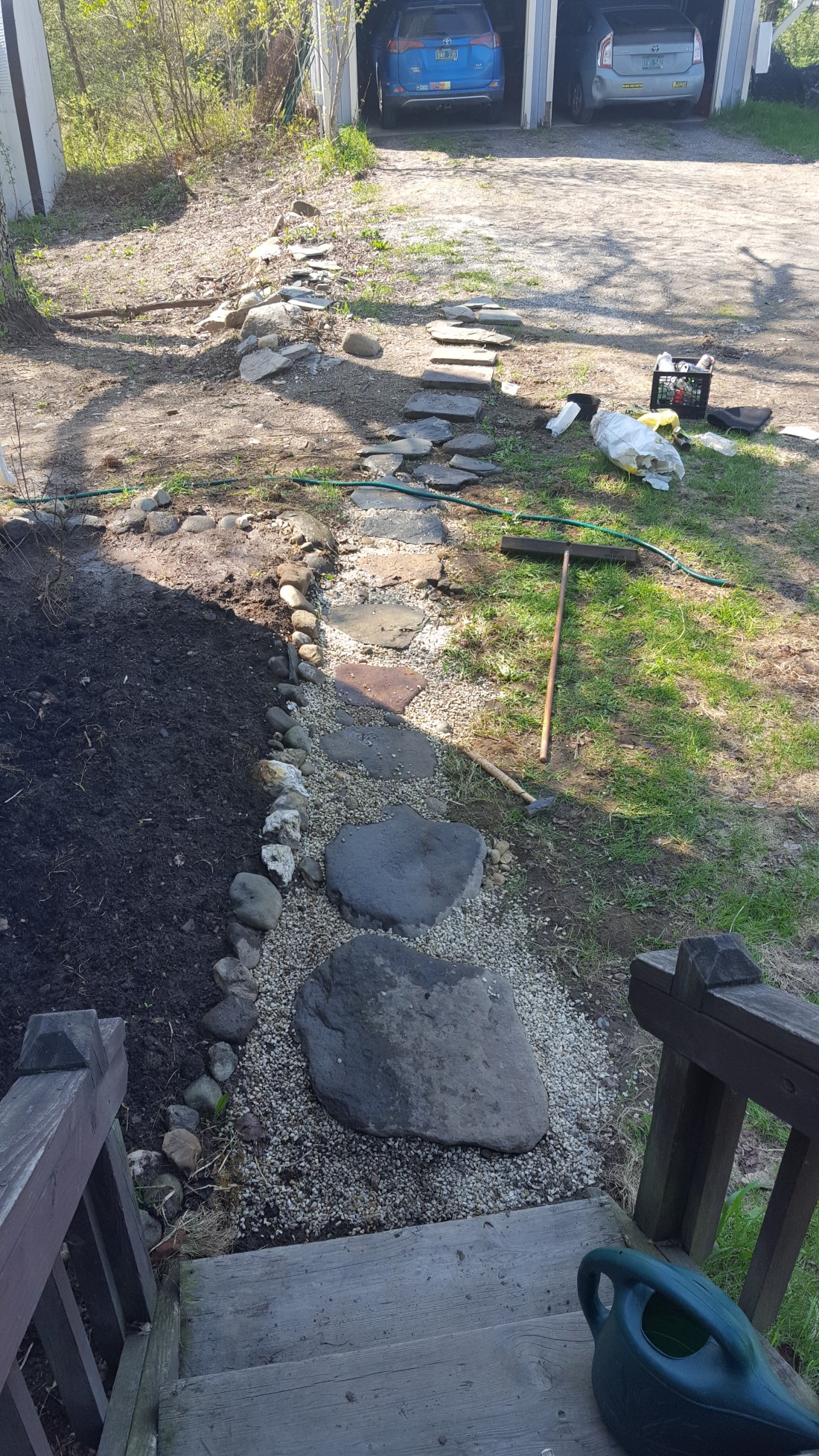
Not satisfied with unmucking the boys’ shed yesterday, Xopher worked on rebuilding the front path today.
It’s the summery day we’ve been waiting for.
Book Corner 2019.24.holy.shit
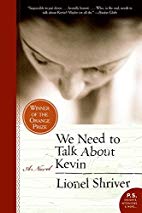
We Need to Talk About Kevin by Lionel Shriver
We need to talk about Kevin.
Right now.
This novel consumed me. In a way, my daily world revolved around that hour or so per night I could get back to the story. Some nights the Disturbing factor was off the charts and I felt uneasy; most nights I just left the book in rapt admiration at how each chapter ending left me dying to know how it would reach its inevitable violent climax.
I didn’t even care about the secondary questions, like “Why does she stay in this marriage!?” and “Isn’t Franklin drawn as just a little TOO much of a jerk? Why does she love him again?” The mother-son relationship mattered too much to care about the realism or frustration in the other relationships.
LOVED the conclusion. No spoilers.
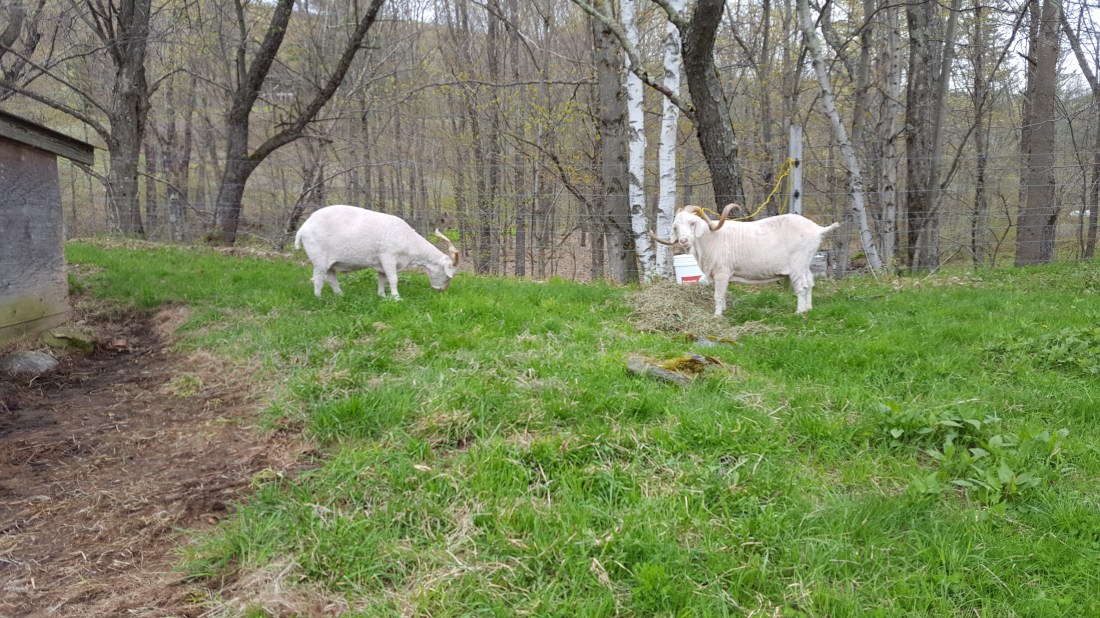
Now It’s Time to Play Our Game
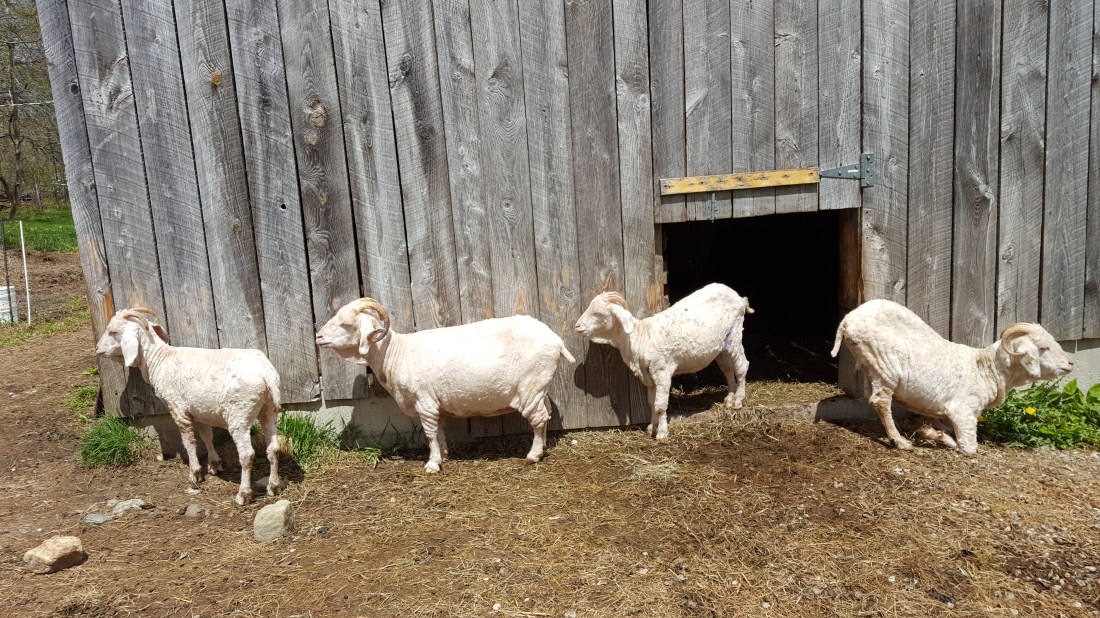
Three of these goats belong together,
Three of these goats are kinda the same;
But one of these goats is doin’ his own thing…
And Then There Were None (Left to Shear!)
4 More Makes 5/7
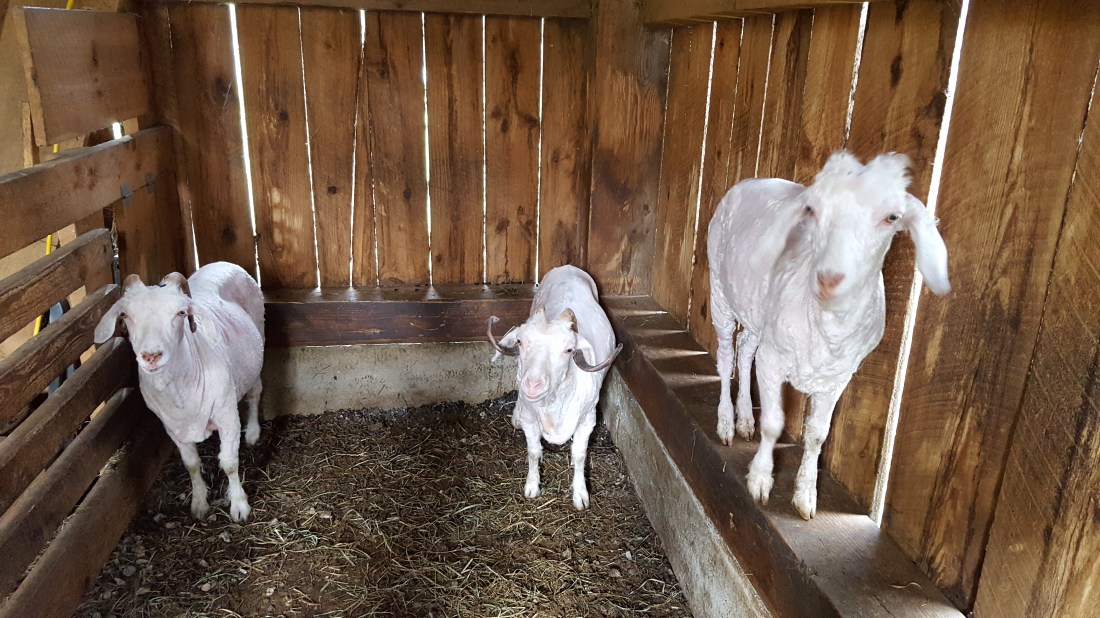
Four more shearings today. From left to right, above: Janet, Columbia, Beatrice. Though who could tell! Except Columbia is developing quite a curl to her horns.
Beatrice yielded 9 pounds; Zowie (not shown), 8 lbs. 12 oz. Both of those will hopefully be sold straight to Green Mountain Spinnery; Beatrice and Zowie are the youngest at only 2 and 3 years old respectively, and they’d been coated all winter.
Janet yielded 8 pounds after I’d skirted (thrown away) a fair amount for filth and scabby skin – she had the bugs really bad. Columbia also had bad bugs, but produced a yield that was beyond my little scale’s capacity.
Now just the big boys remain.
Book Corner 2019.23
A Man for All Markets by Edward O. Thorp
I liked when Thorp told his life story – I love memoirs. I liked his writing voice. I looked forward to learning a bit about how he beat the casinos and then the stock market, fully prepared that it would likely be all above my head.
And yeah it was. Thorp was a young prodigy mathematician. He figured out how to win big at blackjack. It involved counting cards, and memorizing strategies for 500 or so possible deals he might be faced with, and betting larger or smaller depending on where he was in the deck.
Then the casinos got wise to him, made some rule changes about betting, started shuffling the deck on him every other deal, and just plain started cheating, too. He claims it was the cheating that made him give up gambling and turn to investing.
He then devised a hedging approach to investing, which had to do with plotting stock prices an buying certain ones while simultaneously selling them short – I understood this even less than I understood the blackjack, frankly. I tried to get the gist of everything I was reading, but it did go on and on, and I kept wanting more life story.
The book itself felt like it would never end. He gives a chapter of thoroughly boilerplate explanation of the 2008 financial crisis, which sheds absolutely no new light on anything. He gives a chapter of investment advice which likewise fails to shatter the earth. Finally he talks a bit about his own philanthropic outlays – endowing a mathematics chair at UC Irvine, and helping stem cell research. Thorp is still alive, in his 80s.
 Tytania