Book Corner 2021.36

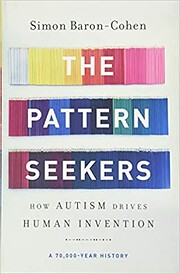
by Simon Baron-Cohen

Simon Baron-Cohen is a psychology professor and author of six hundred scientific articles and four books. He is proposing a theory of Systemizing vs. Empathizing brain types, with the former associated with both autism (well established) and inventiveness (his new theory). Chapters were most interesting when discussing the brain types, and autistic and intensively systemizing people in particular and in general. There were less interesting chapters about how early we can date true inventiveness on the part of homo sapiens; and whether animals can invent. These things did not seem relevant to the theory to me. Baron-Cohen passionately calls out for better accommodations in society for autistic people – they need remunerative work, and to feel valued, and to have friends. These passages made me want to go out and befriend an autistic person. I guess that proves I have an Empathic side of my brain after all. That’s just a joke – he emphasizes that the “empathy” skills that autistic people lack are not those of “affective empathy” – feeling compassion and a sense of justice for others; but “cognitive empathy” – able to put oneself in another’s shoes, commonly called “emotional intelligence”. There are tests you can take in the appendices to see whether you rate as a Systemizer, an Empath, or a “Balance” of the two. I think there was an error reversing the legends of the axes of the graph in Appendix A, however, so I am not sure if I am something of a “Systemizer” (though I am definitely not an extreme one) or a “Balanced” individual. Another appendix lets you quiz yourself to see how many autistic traits you have. I rate about six; so does my husband; this puts us on the “low” end of being “high” in autistic traits.

I was originally mildly surprised that he wasn’t rating more “systemic” or more “autistic” than me; but upon further reflection, I buy it – I think we are both true Systemizers, but in different ways. He has some spot-on spectrum traits – zeroing in on the details all the time, seeing flaws, seeing how things are constructed. Me… my favorite thing in the world is to apply a system and see how it turns out. I am that person who “follows recipes slavishly”. I love cooking and have tried to study those books who teach you how not to need recipes anymore; but, I LIKE following recipes. I do them to the letter as well as I can, and I don’t peek at the ending. Likewise I follow knitting patterns slavishly. I don’t try to adjust my recipes or patterns as I go along; I am totally non-intuitive, because that is what I LIKE. I want to apply the system, apply the rules, see what I get. Something I used to do when I was a kid was come up with a wacky system for coloring a picture: all the things that begin with “A” will be this color, “B” will be this color, etc. I would end up with something nutty, but the point was not to end up with a beautiful picture – though it would be awesome if that happened – but just to see what would happen. I also used to pick colors at random a lot. I still like randomizing my life. Can’t describe it any better – I just like to see what happens – and the more I think about all the aspects of my life, the more this seems to apply: I like to have systems and apply them.
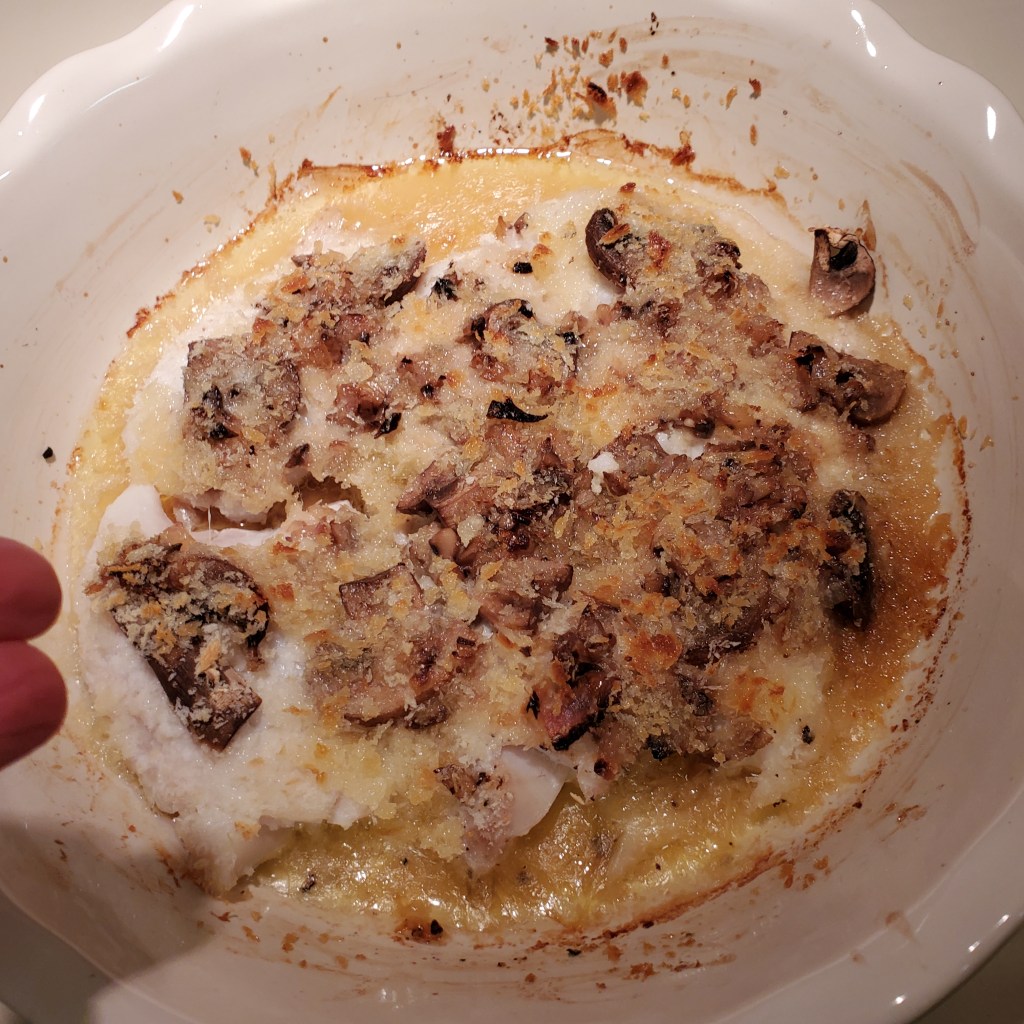
Fish au Gratin

Fish au Gratin

In a rare straying from vegetarian cooking I tried this NYT magazine recipe last night, and X deemed it “excellent,” as did I! That’s mushrooms and breadcrumbs on top. Copious butter, and some white wine, white vinegar, and lemon juice round it out.

From the department of Don’t Tell Anyone: Sometimes I think X thinks of me as some kind of household appliance. But it’s OK because sometimes I think of him as some kind of a pet.

Book Corner 2021.35

by Donella Meadows

Recommended to me by a coworker. Tries to teach you how to view problems not in isolation but as systems – interactions of many variables at once. Tries to help you identify the likely leverage points – places where you can most efficiently effect changes in the system, hopefully in the direction you want (not guaranteed).

Book Corner 2021.34

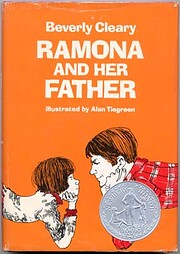
Another Ramona re-read for me. Ramona is back in second grade; and her father has lost his job. Ramona faces her usual grade-school trials and tribulations, but this time her troubles are driven mainly by family dynamics. Everyone is short-tempered, and the cat doesn’t like the cheap cat food, so he eats the jack-o-lantern. Beezus fights with the parents, which makes Ramona cry. She’s reassured repeatedly that the family will get another pumpkin to carve, but that’s not the issue. “Didn’t grown-ups think children worried about anything but jack-o-lanterns? Didn’t they know children worried about grown-ups?”

It’s not all down. Ramona and her friend Howie make coffee-can stilts and delight in stomping all over the sidewalk belting out “99 Bottles of Beer on the Wall.” It takes them all through the evening through a rain shower, but they make it from 99 down to 1. Huzzah! I love the young Ramona who delights in noise.

And the final episode, where Ramona participates in the church nativity scene dressed in a home-made ragtag sheep costume, is priceless. Ramona Forever!

June Deer

Deer on Kelley Rd

I have off tomorrow for Juneteenth! This was a big surprise that came at 3 PM today.

You know you’re in the right job when one of your first thoughts is “But tomorrow I was looking forward to _____”. And you know you’re in the right life when you can shake that off and say, “Time for that Monday!”

Book Corner 2021.32 Good Quotes

“Everyone has a story they tell themselves about themselves. Even if they don’t explicitly acknowledge it, their minds are at work retelling or editing or updating a narrative that explains or excuses why they have spent their time on earth as they have.”

“The one shot America had at behaving well, and thus saving itself, was to remove the feeling that ‘the government’ was imposing restrictions on people and re-instill the idea that people were imposing order on themselves, to fight a common enemy.”

“[N]ever in the unwritten history of nasal swabs had nasal swabs been awaited with such anticipation.”

Book Corner 2021.32

by Michael Lewis

This is a book about the handling of the COVID-19 pandemic in the US; but it’s written by Michael Lewis, so it’s not going to be a polemic or a dry history. It’s a book about a few real-life characters who had some interesting roles to play, and their unique perspectives.

– Scientist Bob Glass: his daughter’s (and, let’s face it, his) eight-grade science project is a model of communicable disease spread, which points the super-spreading finger mainly at children, for their multitudinous and highly physical social interactions. The model concluded that closing schools and keeping children isolated was the best way to stop the spread of a flu-like illness, counterintuitive though it may seen when it’s the older cohorts who suffer the most adverse effects.

– Charity Dean: a California public health officer with a hero complex; I had a hard time truly understanding her character and her motivations under different circumstances. She also just didn’t seem all that important to the story.

– Richard Hatchett: one of the first picks to work on a task force to produce a pandemic plan of action back in the George W. Bush administration; because President Bush had read a book (!) called THE GREAT INFLUENZA about the 1918 flu pandemic, and it scared him into wanting to craft a governmental plan of action to deal with pandemics. (Yes, the last Republican president whose initials were not DJT actually read books – those were the days!)

– Carter Mecher: kind of the main character, someone that Lewis obviously respects a great deal; a doctor at the Veterans Administration, and unofficial leader of the task force.

So the pandemic plan is written with its emphasis on social distancing and closing schools. During the Obama administration, there is the H1N1 scare, and the plan is considered; but they take a gamble and decide it’s too intrusive into people’s daily lives, and they don’t use it. They dodge a bullet; I think there is a comment to the effect that it wasn’t a bullet dodged, but rather that nature had chosen to spray us with buckshot. The pandemic response team is ultimately disbanded, and then we get Trump. There’s also the politicization of the CDC; the CDC is not so much a villain in the story as a tragic anti-hero. They could have been so much better, done so much more. Instead, at first they minimized.. and then surrendered.

It took about half of the volume to finally get the narrative up to 2020 talking about COVID-19. Until then, I was chomping a bit at the bit – get to the good stuff already! These people are all relatively interesting but I didn’t buy a book to read about a bunch of government scientists and doctors with some novel ideas. After all the backstory, things got very compelling indeed. I have long been a Michael Lewis fan and continue to be. Ugly cover, though. (  )