Book Corner 2021.50

by Sebastian Junger

The author treks west across Pennsylvania with a group of other former combat veterans, following railroad tracks, secretly camping wherever looks safe, and eating big diner breakfasts and dinners. Why? Not clear. We find out way near the end that Junger is going through a divorce, which may be relevant.

I did not realize that it is illegal to walk along railroad tracks, thus “trespassing on railroad property.” I certainly didn’t realize that it’s as illegal as it is in this book. The group of hikers is constantly dodging into the woods, wondering if distant sirens are for them, wondering if someone who said hi is going to turn them in.

But precious little of the book is about hiking, camping, roughing it right in the middle of civilization, or our narrator’s journey. It’s digression, digression, digression. Ireland, Native Americans, Eurasian nomads. The overarching theme is not freedom, but fighting. All the digressions were about warriors, basically. Not interesting to me. Not the book I thought I was going to read.

Problems

Maybe instead of counting their blessings, people should count their problems.

a) Maybe counting your problems will get you used to the fact that ye problems, ye will always have with ye

b) Maybe counting your problems day after day and noticing how you nevertheless continue to exist and function would be therapeutic

Problems! I got ’em! Count ’em and weep!

Tonight I have a goat who is very sick indeed. Not even the one who broke her horn.

The Goat-Owning Problem-Free Life

So I haven’t gone on about this yet, but this past weekend was shearing weekend. And we went out Saturday morning, a beautiful day, all gung ho and set to shear as many goats as we could… and Columbia’s face was COVERED in blood. In the barn we found a POOL of blood. She had suffered a grievous horn injury – and not the first time; in February 2020, her other horn had come off right in Xopher’s hand. And horns bleed a LOT.

Ouch!

I almost felt like I wanted to pass out, but Xopher was relatively nonchalant.

The next day he tells me he wants to saw off what’s left of the horn she just injured. It was really long and curly, and we don’t know exactly what happened to her Saturday morning, but having a really long curly horn is just going to be really prone to getting caught on things, knocked around, and injured.

He assures me that horns are only alive for a few inches, and most of the horn that we see on an adult goat is just like hair or fingernail. But I’m totally squeamish – sawing off an already injured horn. Ich! Ugh! But what can I do? I put the whole thing in his hands. I sat there and did my part to hold her down while he sawed away. First he was using an electric rotor saw but it fell and got busted early on, so he had to resort to a manual hacksaw.

I sat there trying to mentally check out as much as possible. And I thought about this passage:

“Most of us treat the problems we encounter as doubly problematic: first because of whatever specific problem we’re facing; and second because we seem to believe, if only subconsciously, that we shouldn’t have problems at all.”

Really how many times do you tell yourself that? Usually it’s in the context of how much money we have, and how “first world” our problems are. We start ticking off all of our blessings, and literally say to ourselves, “Hell I shouldn’t have any problems at all.” But of course we have problems!

So I sat there thinking about how the problem-free life will never happen – certainly not the goat-owning problem-free life. And here holding a goat down while my husband saws off her injured horn – it’s just one more of those problems, those problems that always have been and always will be.

And reader, that helped.

Hello, Beautiful World

The Beautiful World

‘I think, for most of my life, until I did kind of wake up to forests and to trees… I did share this cultural consensus that meaning is a private thing that we do for ourselves and by ourselves

We can make purpose and make meaning completely arbitrarily. It consists mostly of trying to be more in yourself, of accumulating in one form or another. And when you do subscribe to a culture like that and you are confronted with the reality of your own mortality, as I was when I was living in Stanford, that sense of stockpiling personal meaning starts to feel a little bit pointless.

And I think what was happening to me at that time, as I was turning outward and starting to take the non-human world seriously, is my sense of meaning was shifting from something that was entirely about me and authored by me outward into this more collaborative, reciprocal, interdependent, exterior place that involved not just me but all of these other ways of being that I could make kinship with….’

Richard Powers in an interview with Ezra Klein.

More Burkeman

“Why assume that an infinite supply of time is the default, and mortality the outrageous violation? Or to put it another way, why treat four thousand weeks as a very small number, because it’s so tiny compared with infinity, rather than treating it as a huge number, because it’s so many more weeks than if you had never been born?”

Hay

“Life, I knew, was supposed to be more joyful than this, more real, more meaningful, and the world was supposed to be more beautiful.” Oliver Burkeman quoting “environmentalist and spiritual writer Charles Eisenstein.”

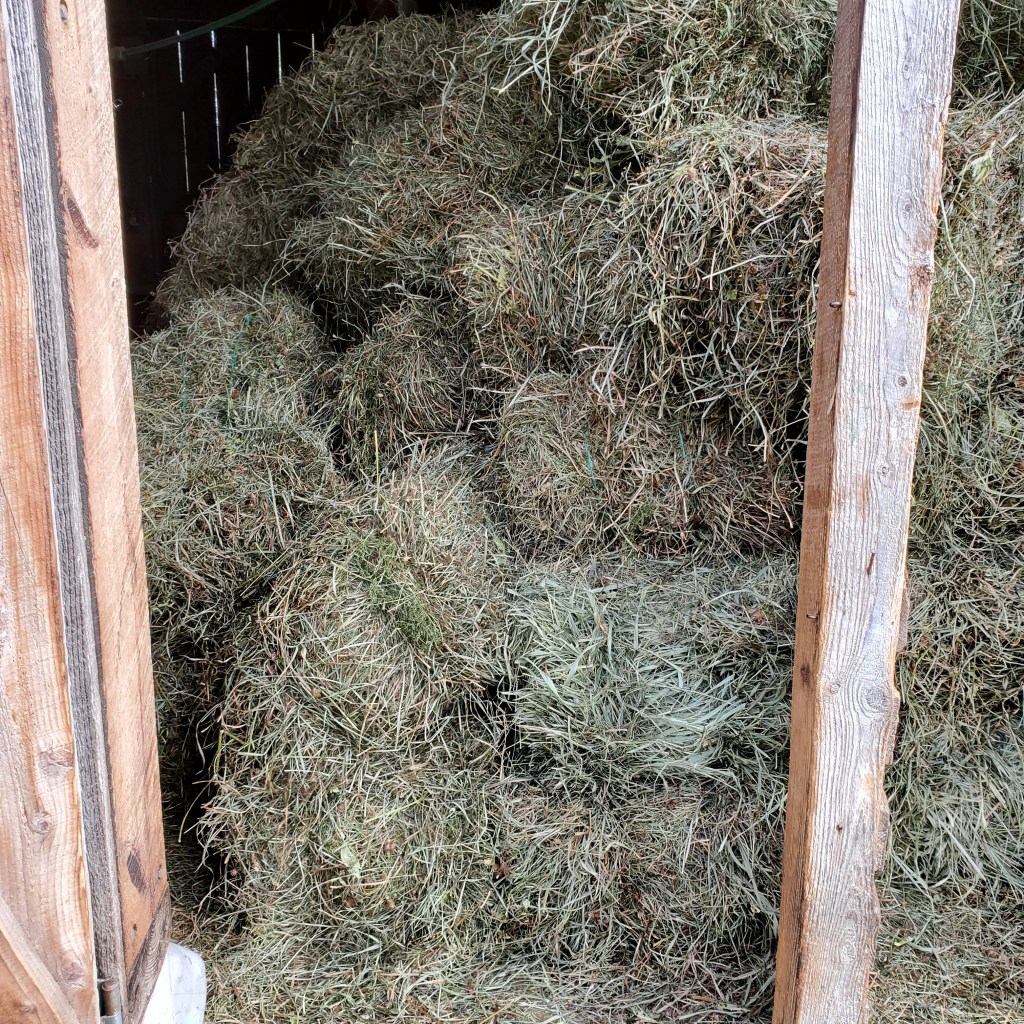
Winter hay in the barn, ready to be hoisted into the loft this weekend.