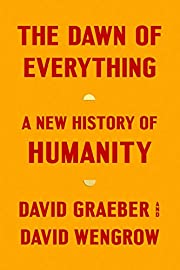
by David Graeber & David Wengrow
Where to begin reviewing a book weighing in at nearly 700 pages from title page to end of index?
We open and close with a lot about freedom. Our first section is totally arresting, as we delve into how the Americans who preceded Europeans on this continent viewed European culture: with disbelief and disdain at our lack of freedom. While we Eurocentric people have always tended to view ourselves as being quite free, our “formal” freedoms were as nothing compared to the “substantive” freedoms found in America.
More on that in a moment, but notice my avoidance of terms like “indigenous people” or “Native Americans”. They were Americans. They lived here. I love the radical respect that the authors give to those people who lived in this place before us. And those Americans who engaged in thoughtful substantive debate with their European interlocuters, they rightfully refer to as philosophers, even “philosopher-statesmen”.
So about those freedoms: we theoretically have the right to travel, but if we haven’t got moolah, we effectively must stay put. Many of the earlier American societies had kinship networks far and wide, and people really could travel whenever and almost wherever they wanted, knowing they would have kin that would have their backs. We formally have the freedom to do whatever we like, but we have authorities we must obey. North Americans the Europeans first contacted often did not. Their chiefs had no real authority to make anyone do anything. In a great turn of phrase, the authors say “the Wendat [Huron tribe of native Quebec] had play chiefs and real freedoms, while most of us today have to make do with real chiefs and play freedoms.”
And so the book continue with more of its radical upendings of our typical outlook on things. Pre-historical societies experimented with vast, vastly different ways of self-organizing. We weren’t just “bands” (they always put that word in quotes) of ape-like hunter-gatherers, living in one particular default way, until bam, finally agriculture changed everything. We weren’t always all the same and agriculture didn’t all of a sudden change everything everywhere.
One item I couldn’t help but bookmark: “There is an obvious objection to evolutionary models which assume that our strongest social ties are based on close biological kinship: many humans just don’t like their families very much.” I’m sorry, why isn’t this called out more often? Most of us, given the slimmest of chances, will get as far away from our families as the train tracks will take us. Not that I have an axe to grind on this particular topic.
I’m sorry I can’t do justice to more of the book, because there is much, much more. But these were my takeaways.