Book Corner 2020.9

Vacation means books.  (And being at home means books too, but vacation means backlogs of book reviews.)

temp

If You Lived Here, You’d Be Home By Now by Christopher Ingraham

Ingraham manages to write “how we traded the DC suburbs for a remote county in Minnesota” without a) making me hate him or any member of his family, b) talking down to, or dismissively around, any Minnesotan, or c) treating it all like some kind of miracle. That’s an achievement!

I’ll recap the plot here, because it is such a great story: Ingraham crunches data and writes gee-whiz pieces for WaPo. He finds some data about the most pleasant counties to live in across the US, in terms of geographic features, weather, and things like that. Since every county in the country is ranked, not only are some places best, but some are inevitably the “worst” places to live – where were those places? Well, bottom of the list turned out to be Red Lake County, Minnesota. After Ingraham points this out in his article, he gets some hate mail – Minnesota style, which means understated and not very vitriolic – and invitations to come out and see their “ugly” county for himself. Which he does. And he likes it.

And he moves there!

Very interesting to me on a personal level is that Ingraham contrasts Red Lake County not just with the Baltimore/DC area, but with other places he and his wife have lived as well – including my county in Vermont. And Vermont doesn’t come off very well. Vermonters aren’t as welcoming as the Minnesotans; the Ingrahams made some friends, but never felt part of a community like they do in Red Lake County. I believe it. We’re pretty standoffish round these parts.

“If there is one thing – one sole, solitary piece of information – that I can convey to you about rural America it’s this: rural America is not a nation apart. The people here are just as complex and fallible as people anywhere else. They consume the same media, cheer for the same sports teams, fight over the same political issues, and have the same dreams for their kids.” I like that. ( )

Book Corner 2020.8

temp

Uncanny Valley by Anna Wiener

It kept me reading. I liked the coy refusals to name any company, making us feel like we might be living in a similar but other world: the “social network everyone hated,” the “search engine,” the “litigious corporation based in Seattle.” At one point she not-name-drops my favorite blogger, “a libertarian economist” and describes him in a not altogether flattering light. I wrote to tell him about it, and he responded, yes, “the book is fiction in a number of respects.” She’s not the only one who can be coy. My interest waned a bit when I realized that nothing was really going to happen. ( )

Book Corner 2020.7

temp

The Eating Instinct by Virginia Sole-Smith

Discusses all the different ways eating can sometimes be anything other than a simple, pleasurable, nourishing experience. The impetus for the book was the author’s baby born with a congenital heart defect, which required surgery and for her to be put on a feeding tube as an infant; Violet then refused to eat for many months, even after the tube should no longer have been needed. It was an arduous journey getting Violet to eat. This drove the author to examine other ways and reasons humans may not or can not do such a simple act as eating; she discusses babies with adverse reactions to milk, anorexics, severely “picky” adult eaters, people too poor to eat properly, and of course just plain women born and bred to this diet-crazy, thin-obsessed culture. It was absorbing. I’m not usually into “kid stuff,” but she told Violet’s story and the other baby/kid/parent stories in such a way that made even me interested. ( )

Book Corner 2020.6

temp

Mansfield Park: an Annotated Edition

by Jane Austen, annotated by Harvard University Press

Even with the annotations, I was soon reminded why this is my least favorite Austen. Fanny is a pretty insipid character to spend this amount of time with. Book I is so great, though – the young people getting carried away with their theatricals, the Bertram sisters withering in their jealous vying for Crawford’s attentions, Rushworth just so wonderfully stupid and clueless, and all of it culminating with Sir Bertram’s unexpected return literally in the middle of all the ranting and strutting upon the stage. Ha! If only the rest of the book were as fun. After that climax, it would have been better if it had ended much more quickly. And all I can say about the Mary-Edmund romance is she must have had one damn fine pair of ****- the way she disparaged his chosen profession, her crassness, her obvious lack of any of the fine virtues he purports to hold so highly – it was very hard on the page to accept him being so smitten with her.

The annotations in these Harvard editions are great – not overly intrusive, as in other annotated classics I’ve read where they feel the need to define every other word. They occasionally veered off well into “who cares” territory, so I skipped some of them. I like when annotations shed direct light on the culture and customs that lie behind the brief or antiquated words of the author. ( )

Book Corner 2020.5

temp

Milkman by Anna Burns

I was very glad to see this book end.

It’s dense, first-person, and rather stream-of-consciousness. One paragraph will frequently span a page. And the subject matter is tough – life in a Northern Ireland city under the IRA, or “renouncers” as they are strictly called here. As tough as the renouncers themselves are, the entire community serves as a kind of character itself, enforcing rules and behaviors on what seems every aspect of people’s existence. It was absolutely vicariously stultifying to read. While nobody is allowed to give their baby the wrong name, or be seen with the wrong person or live in the wrong district, the town seems perfectly willing to tolerate lunatics and murderers in their midst – not only the renouncers, but garden-variety nutjobs, too.

An extremely obtrusive gimmick of the story is that absolutely nobody is named by name. Everyone is referred to by shorthand nicknames, relationships, and birth order. This intensifies the feeling of the unimportance of the individual in the midst of a community where conformity is all-consuming.

There is plot, and there is character, so as a novel it was not as much of a slog as some modernist tomes. And there is catharsis – but what was perhaps most annoying, towards the end as the plot is winding down, you finally want to start breathing freely like the narrator; and suddenly, we zip back in time a couple of weeks with a pretty silly subplot. That just put me over the edge of dislike; I haven’t been so happy to finally reach the end of a book in some time.

And silly subplots there are, but it was usually hard to laugh at the humor, couched as it was in the middle of difficult subject matter, and a narrator having a nervous breakdown most of the time. ( )

Book Corner 2020.4

temp

Unsheltered by Barbara Kingsolver

Two stories going on at once, and as usually happens, I liked one much more than the other.  The protagonist of the modern-day story, Willa, is really a riot; a 50-something matriarch in a house that is literally falling apart.  Every other line that comes out of her mind is funny.  This story reminded me of The Mandibles by Lionel Shriver – in that case, the whole U.S. economy was falling apart; whereas Willa only has to deal with her own house and family.  But the sarcastic middle-aged woman trying to keep it all together is common to both.
In the other thread, a house on the same lot (though, we find out, not actually the same house) is coincidentally also falling apart – but over a hundred years in the past.  This story reminded me a bit of the Lydgate sub-story in Middlemarch – the ambitions of a man of science brought low by a pretty face.  Unfortunately I found this story mostly tedious and exaggerated.  The character of Mary Treat, the woman scientist, is intriguing; but the minor female characters (Polly, Selma) hit you over the head with caricature.  And the conversations just go on forever. 
Come to think of it, the conversations tend to drag in the modern-day story, too.  The characters are a bit better (though I disliked how Tig was always implied to be in the right).  And I really did look forward to getting back to their story – ceilings falling down; a tiny half-orphaned infant to tend to; and a hysterically funny, racist old father-in-law on life support.  Kingsolver at her best.

Book Corner 2020.3

temp.jpg

The Lighthouse Keeper’s Wife by Connie Scoville Small

It’s funny how I got this book. My husband was telling his mother about the Maine Lighthouse Museum in Rockland which we visited this past September, and how he found it to be a very haphazardly run place considering their impressive collection. Yeah, I piped up, and told a little story about how they had talked up this memoir written by a lighthouse keeper’s wife, and got me real excited and wanting to read it, and there wasn’t nary a copy of it in their bookshop. My mother-in-law said, oh, I think I have that book; and she fished it out. Sure enough, this was the very book!

“[A] life of people risking their own lives to help men and ships; a life of order and duty.”

This is how Connie Scoville Small describes her life of living in lighthouses along with her husband Elson, in the near-conclusion of her memoir, THE LIGHTHOUSE KEEPER’S WIFE.

From 1919 to 1947 the Smalls tended lighthouses up and down the Maine coast. I myself have little experience with life on the sea, and little patience to read through long descriptions, along with little ability to place myself in long-drawn-out scenes of nature with which I have little familiarity. I don’t think it was just me, though; Connie often seems to drop us into scenes with little in the way of helpful background explanation.

That said, I kept reading because I love slices of ordinary life from early in the last century and beyond. I could not easily picture the lighthouse-specific and maritime and boat scenes, but I loved reading about the family’s cats and cows… and of course the food. Lots of baked goods!

Rarely does Connie give us deep insight into what she, or, perish the thought, Elson, are feeling about the big picture. But here is a glimpse:

“I put inside of me my desires, my longings, things I wanted to do, if they came in conflict with what he wanted. I felt what I wanted were selfish desires… I gave and I’ve never been sorry… I wanted to rebel, desperately so at times, but I didn’t… I filled my life with Elson… I’d be so busy making it work and doing things he wanted me to do… I forgot to be unhappy and found joy.”

So different from us today. That’s why I like to read old memoirs. ( )

Check out the title link for her obituary – she died at 105!

Book Corner 2020.2

20200108_184025.jpg

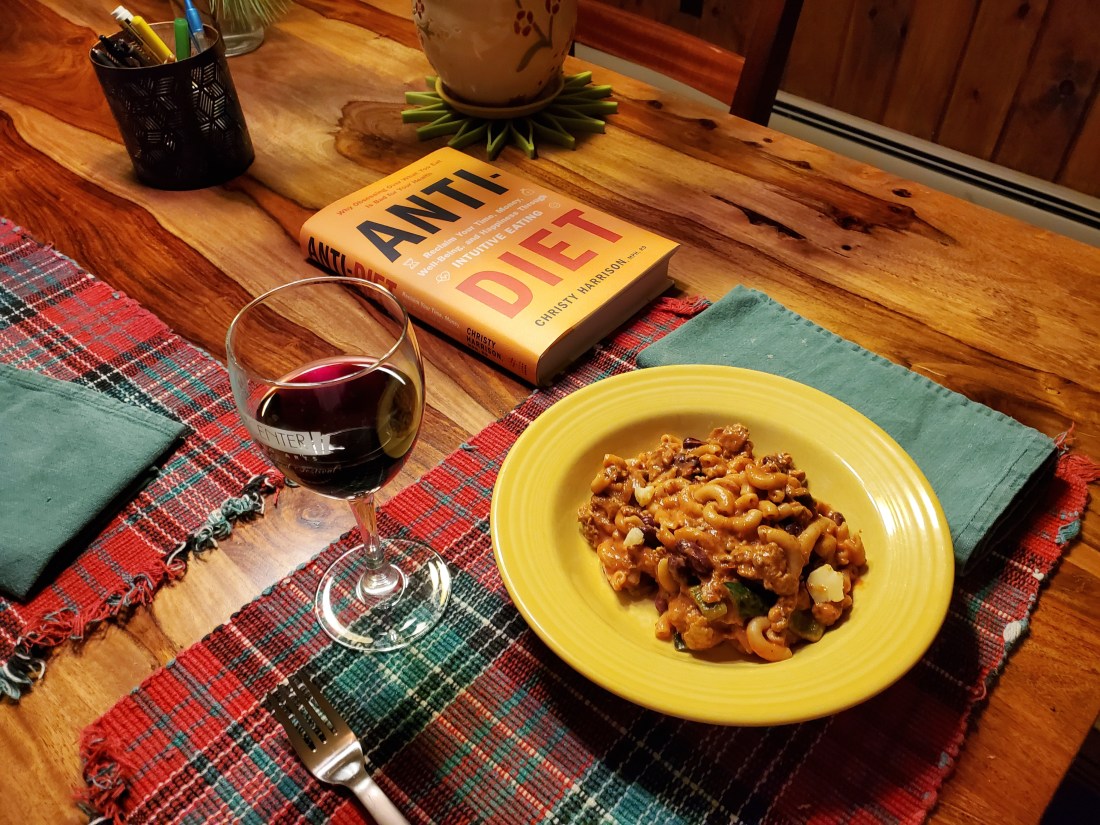
The Anti-Diet by Christy Harrison

Just like THE F*CK IT DIET by Caroline Dooner but with very little swearing. Harrison is a registered dietician, and uses what she knows to convince you that Health At Every Size (HAES) (TM) is the only way to go. Lots of proof showing that diets don’t work, don’t last, and actually make you gain weight (NOT THAT THERE’S ANYTHING WRONG WITH THAT!). Seriously, Harrison is always bending over backwards not to offend (with constant shout-outs to non-binary-gendered people), refusing even to use the words “overweight” or “obese” without quote marks.

There is only a very short chapter about how to do truly intuitive eating. Like THE F*CK IT DIET, this book warns you that by “intuitive eating” we do not mean being obsessed with hunger cues, which is just dieting by another name. F*ck-it-style intuitive eating means: just eat. Whatever you want, whenever you want, however much you want. Enjoy.

Who couldn’t get behind that?

Harrison gives lots of reassurance that this will NOT ruin your health. After a honeymoon phase with brownies, you will settle in, your weight will settle in, and your health will be fine – or not – but if not, it won’t be because of eating the wrong things. Lots of factors contribute to health, including many beyond one’s control. And dieting is about control, so that’s not a message many may want to hear.

But it’s true; and other things that are true are: adipose tissue itself has NEVER been proven to DIRECTLY cause health problems. It’s just body tissue, after all. And: being health-obsessed, or even health-conscious at all, is not a moral obligation. There are no “good” and “bad” foods because an apple and a hamburger are MORALLY EQUIVALENT. Running a marathon and watching a Netflix marathon are MORALLY EQUIVALENT. What is “health” for, anyway? To let you live longer and more productively … to do what? Whatever is meaningful to you, THAT is the moral obligation; not health per se.

This would all be obvious if not for what Harrison terms “diet culture,” the water we all swim in. We are all afraid of being or becoming “fat” and what it will mean for our status. But this sounds shallow so we cloak it in talk of health-consciousness and “wellness.”

Just chuck it all. In other words, F*ck It. ( )

Book Corner 2020.1

1250146054_01__SX142_SY224_SCLZZZZZZZ_

American the Anxious by Ruth Whippman

Started out strong, and had a hysterical, dead-on chapter about meditation, or as Ruth puts it, “Meh”-ditation. The theme really isn’t about how Americans are too anxious; but about the ridiculousness of the happiness quest and its associated industry. Ruth’s discovery seems to be that happiness is other people. I beg to differ, but I still cheered on her take-down of mindfulness.

Unfortunately it frequently devolved into that kind of non-fiction book I hate, the kind that reads like a research paper. “Research shows this. It seems that that. Turns out that…” And chapters about parenthood and Facebook were boring, with nothing we haven’t heard a zillion times.

Even amidst all of that, though, I still found myself frequently laughing out loud – not just chortling but outright guffawing. Maybe it’s the Britishness of her humor. ( )