Double Whammy

A double whammy is when one of my heroes interviews another; such as Malcolm Gladwell interviewing Oliver Burkeman. This is a lovely interview and unusual in the welcome respect that they don’t spend all that much time asking Burkeman questions that just cause him to repeat everything I’ve already read in the book. It goes more like a therapy session. We learn that Burkeman started getting obsessed with maximizing him productivity at a very precocious age; he faults his over-anxious, get-to-the-airport-14-hours-early father. But I was like that myself, and I think some of us are just hardwired as such. When Burkeman tries to turn the tables, and prods Gladwell to talk more about how he grew up in such an opposite environment, I’m as fascinated as he is. While Burkeman’s parents said, “Just do your best,” which sent him into a tailspin thinking that he couldn’t slack off for a moment or it wasn’t his “best”… Gladwell’s easy-going parents said, “You’re bored? Good! It’s good to just drift along once and a while…” and Gladwell grew up embracing the easy-going life. But he keeps dodging the question of how he’s become so successful without that drive towards productivity – why isn’t he working at a surf shop in Bali? I’d love to know.

Large chunk of the relevant transcript follows, emphasis added by me; in these spots I particularly wonder if these people are genetically related to Xopher:

Oliver: What would be the motivation to have written all the books that you’ve written and to have created all the other content—podcasts, audiobooks, everything else—what would be the motivation to have got on to that escalator in the first place if you were just completely relaxed about your relationship to the world? 

Malcolm: I may have inherited it from my parents. I don’t think of either of my parents as being future oriented. They were people we never discussed tomorrow. We only ever discussed today. And I never think about tomorrow. Really. Not much. My most powerful memories of my parents—my father is no longer with us; my mother is very much—are of them being in the moment. 

My father would only ever talk about what he was doing, and he would almost never talk about what he intended to do. And my mother was always celebrating the thing that was happening. She’d make a fresh scone, and eat it, and then she would say something to the effect of: “At this very moment, eating this particular scone, I am insanely happy.” 

I’m not thinking about tomorrow

Book Corner 2022.13

by Weike Wang

This wasn’t quite what I was expecting. What I was expecting from JOAN IS OKAY was something along the lines of ELEANOR OLIPHANT IS COMPLETELY FINE. Both are about misfit women. (And both women are either OK or completely fine.) But ELEANOR is played for laughs and sentimentality, while JOAN was completely serious and refused to follow any predictable narrative arc.

Joan is an ICU doctor who lives inside her work. She enjoys nothing more than being a cog in a machine. She has odd, not-exactly-close yet not-really-distant relationships with her mother and her older brother, and likewise had with her father, whose death back in China opens the novel. Her relationships with her co-workers are also not cold or distant or weird, but odd, in a matter-of-fact kind of way.

Joan gets a new neighbor across the hall who infiltrates her life in a frankly creepy-friendly way. He gives her food, objects, furniture. As this guy noses in more and more, his furniture filling her previously spartan living space, one would be forgiven for thinking: ah, now here is where the fun young guy shows Joan, one piece of furniture at a time, how to live, laugh, and love! But, no. It is not that kind of book at all.

The author is not a medical doctor, but she is a chemist with a doctorate in public health. It’s always so refreshing to read about characters who are in STEM. Writers only ever seem to write about other writers, usually thinly disguised as “artists.” (I always imagine them thinking, “It’ll be way too obvious I’m writing about myself if I make her a writer… I know! I’ve got it, she’ll be an artist.” Right, they’ll never suspect.)

Far Afield

Winter is just effing relentless. We are very bored. We drove, what, two, three hours yesterday just to be in a slightly different place. Wantastegok.

The meal we had at T. J. Buckley’s of Brattleboro was worth a drive even further than that. I do not think you can dine like this anywhere in the Burlington area. It’s a tiny place. “Located in a restored 1925 dining car,” you can peer over at the one-man-band making your meal. And I did – my scallop dish was so phenomenal, I kept looking over my shoulder, saying, “Really? Really?” As in, this came out of that one guy and that little room right there? Somehow if there were a closed door and an undisclosed number of people and gadgets, it would be more believable. Oh gosh, I’m hungry just remembering it. I kept getting notes of vanilla. If there was vanilla in it, they didn’t disclose.

Oh, understand that prices were through the roof, and justifiably so. I’m so glad we went, though.

Book Corner Abandonment

by Nikole Hannah-Jones & the NYT Magazine

Hi [Friend Who Gave Me This for Xmas]!

I’ve read a little more than half of the 1619 Project and I think I’m going to bail.  It’s just one horrible thing after another.

It’s a tremendous work of scholarship, and given all the over-the-top controversy about it, I’m glad to have acquainted myself firsthand with at least half of it.   From what I’ve read about the accusations of historical inaccuracies, they seem to be a matter of misreading and of interpretation, not the result of actual poor scholarship, IMHO.

What I remember most about Ta-Nahesi Coates Between the World & Me was how said that as a kid he hated Black History month, and learning about the civil rights era, because it seemed to be all about black people being hurt.  Images of black people with fire hoses aimed at them, black people being beaten, etc.  That came back to me as I was reading last night and really wanted to be done with it.  I’m glad you gave it to me, I’m glad I read what I read, I’m glad it exists.  Thank you!

Book Corner 2022.12

by Victoria Turk

Somehow I expected more about handling electronic communication at work, and less about dating apps and such. Extremely basic advice. Spot fake news by checking the sources! I do like that phone calls make her shudder. But I disagree with her that you should text a warning before you call. The three words I hate most in MS Teams are “can”, “I”, and “call.” Every fiber of my being screams noooooooooooooooooo you canNOT, while my fingers type the letters “O” and “K” because I’m such a good team player. If they’d just call and rip the band-aid off, it would be better. There was a blessed period when work texting blossomed when nobody called anymore. Then MS Teams made it so easy to make a Teams call. Pththththth on you, Microsoft.

Existential Dread Yarn Factory

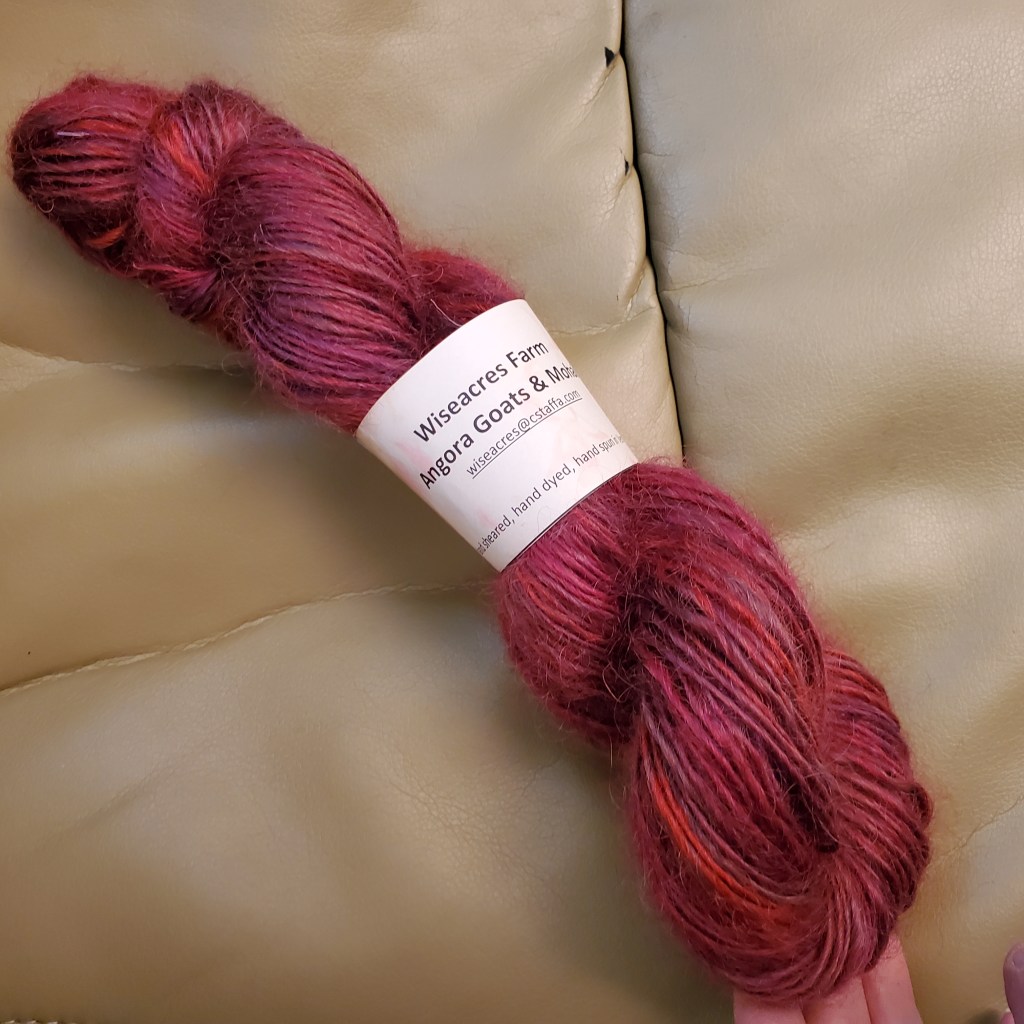
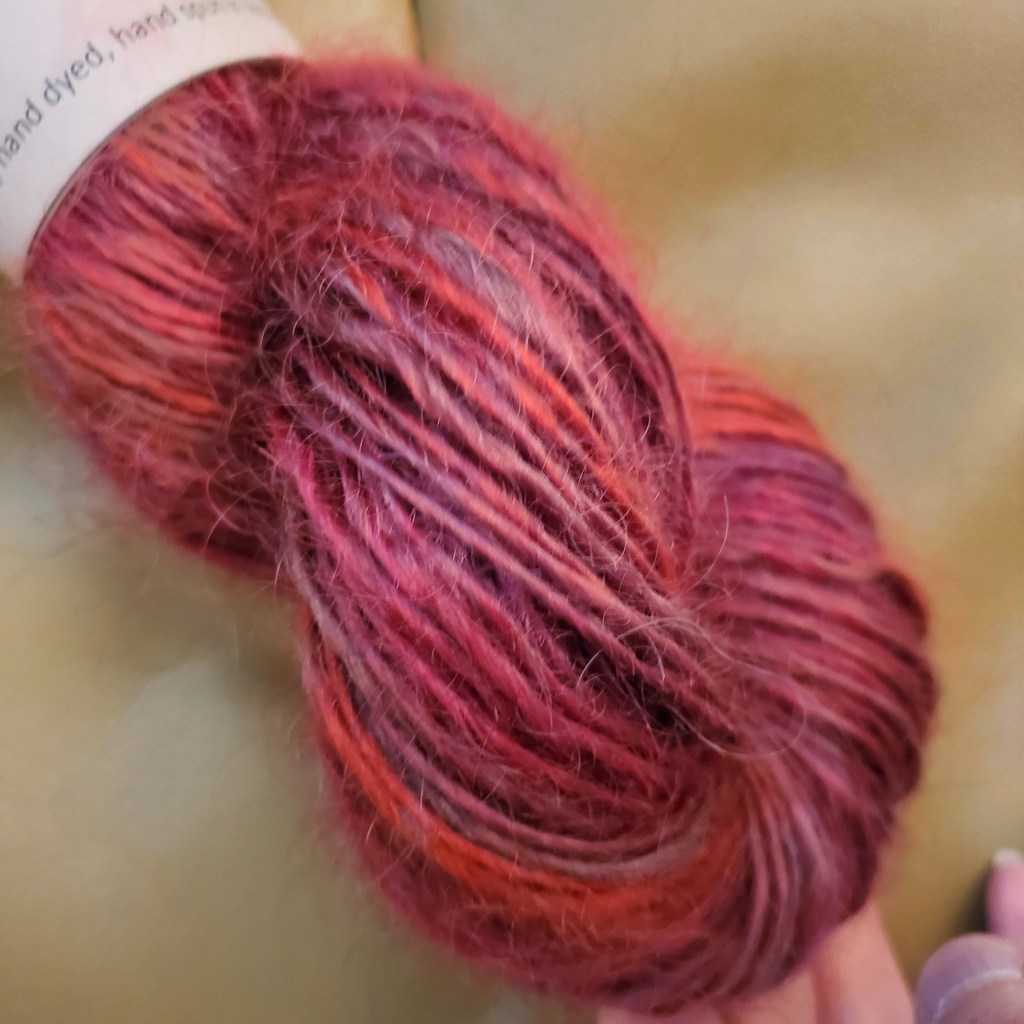
I had the idea yesterday that I should take any money I made from yarn & mohair consignment and give it to Give Directly. This will inspire me to be productive during craft time and make it all feel less pointless. But Tytania, you say, why not just give Give Directly twenty bucks a month and be done with it? It’s like walk-a-thons: why we don’t all just donate to the March of Dimes rather than making kids walk around 20 blocks for it? Because we need not just to be purposeful, to fill our moments with the illusion of purpose; because it’s a horrible, horrible thing looking into the void of meaninglessness!

So on that note, hey! Buy my yarn!

Quite Rightly

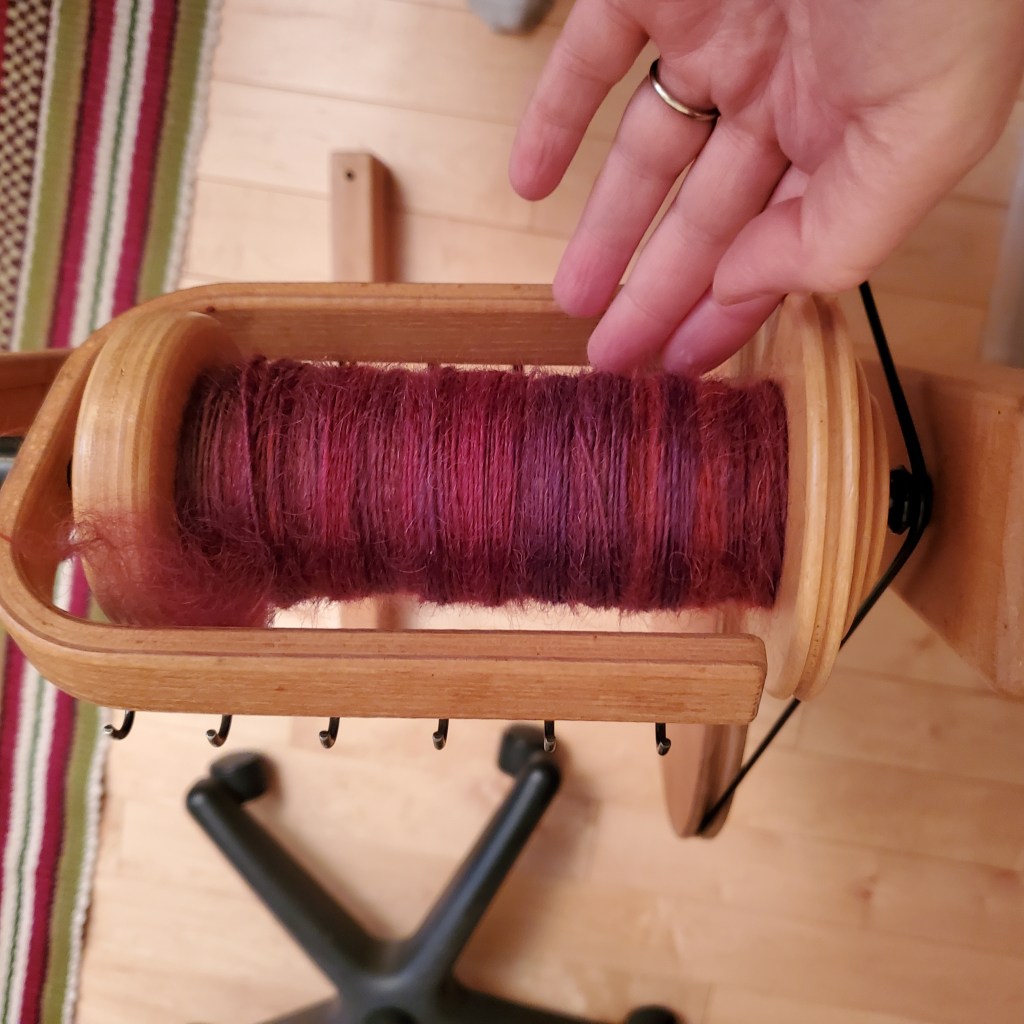
My paltry 2021-2022 yarn output

Finished yarn #3, the solid yellow. 2021-2022 has not been a wildly productive yarn season. I futzed around with weaving a lot. I just received a check from 6 Loose Ladies, second one this year, for $20 and change, for yarn from last year’s drop off. I should focus more on yarn, as it seems to serve some purpose in the world, unlike my weavings which I use for purposelessness like this:

Book Corner 2022.11

by Eugenia Chang

Mathematician Eugenia Chang suggests ways to remedy gender-related disparities in representation, pay, etc. by changing the characteristics that we reward and value, irrespective of gender. So for example, theory: men are more confident, they speak up more, they get noticed more, they get valued more, they get paid more. Common wisdom redress: teach girls to be more confident. Get women to speak up more. Get men to quiet down and listen to women. Chang’s suggestion: Why are we paying people just for confidence and speaking up? The people not speaking up so much – often but not always women – are often bringing just as much value to the table; why aren’t we nurturing and rewarding them for the value they bring, instead of trying to make them more like men?

I think I got the gist of it there. To remove gender from the picture, Chang suggests two new adjectives to take the place of ‘masculine’ and ‘feminine.’ I’ll quote her definitions here:

Ingressive: focusing on oneself over society and community, imposing on people more than taking others into account, emphasizing independence and individualism, more competitive and adversarial than collaborative, tending toward selective or single-track thought processes

Congressive: focusing on society and community over self, taking others into account more than imposing on them, emphasizing interdependence and interconnectedness, more collaborative and cooperative than competitive, tending toward circumspect thought processes

Chang suggests that we picture a society where congressiveness is valued more than ingressiveness. Not ‘as much as,’ but ‘more than.’ Here I feel Chang and I part company, and that her argument could have been stronger if, in a congressive mindset (!), she could have acknowledged that maybe we need the strengths of both personality types to make a good world. But she makes no bones about where she stands: congressive is better.

I like to think that I do not impose on people and am not particularly adversarial. Those are negative personality traits you could argue we could all do with less of, or do without. But what’s wrong with valuing one’s independence? With single-track thought processes? There is definitely a time and place for laser focus. If Chang had merely said, let’s make space for your more collaborative and wholistic-thinker types to flourish, I would have been much more receptive. I certainly love leaving gender out of it. That takes away space for men to get defensive, more ‘ingressively’ inclined females such as myself from getting similarly defensive (not that I ever would), and for anyone to decry ‘reverse sexism.’ Just focus on the individuals being marginalized, and why, and how to fix.