All Kinds of Everything

007.jpg

I did the whole tree today including the lights.  X has done the lights for two decades.  I guess he’s retired.  I did them.  They look fine.

I don’t know how to describe my mojo today.  Low mojo.  But not an existential crisis.  Just low mojo.  It’s like having a cold.

We went to Simple Roots Brewing for beer & Pie Empire Pie.  Then downtown, bought a couple of gifts.  Then dessert downtown.  Too much inedible buttercream.

I love going downtown.  We used to go nearly every weekend.   Now, there are so many other choices.  Maybe I love being downtown because I was young there?  Or because I’ll always miss an urban environment?

And so largely melancholy today… but we came home, with the tree lit up, and damn it looks nice.


Book Corner

natural

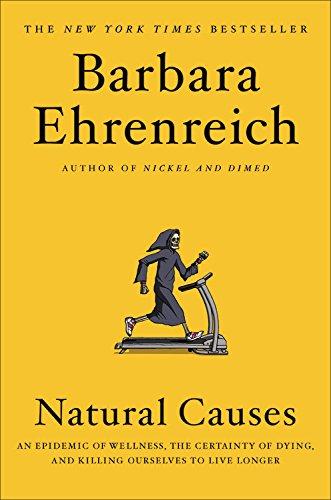
Natural Causes: An Epidemic of Wellness, the Certainty of Dying, and Killing Ourselves to Live Longer by Barbara Ehrenreich

What a title!  Some really great food for thought; sections where Ehrenreich shares her own perspective and personal experience are the best.  She is well into her 70s, and has made the honorable and sane decision (IMHO) not to pursue any further medical tests or disease-related interventions.  She also eats whatever she wants.  You’ve heard it before: Exercise, eat right, die anyway.  She still exercises, though.
Unfortunately, most of the book reads like a research paper, a style of non-fiction I don’t enjoy.  “Here’s the point of this chapter.  Here is every single bit of research I could find – here’s a quote, here’s another quote, but look at this quote.”  At one point I even felt she was contradicting her own self from a previous chapter; chapter 2 makes some really spot-on comparisons between the “rituals” of modern medical care and those of what we’d consider “primitive” healing ceremonies and techniques, a later chapter (I can’t find it, I really need to keep stickies nearby when I’m reading) quotes with implicit outrage some new-agey source making the same comparison.
The chapters written from a personal perspective were very worthwhile.  The book is short at barely 200 pages, so it’s not a slog.  A-OK.


Book Corner

moscow

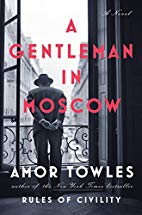
A Gentleman in Moscow by Amor Towles

I liked the main character very much, and generally liked any scenes that examined his thought processes and his interaction with adults around him.  Unfortunately, the author is not really strong in building characters.  And the story involved not one but two bratty kids.  Once the second bratty kid grew up, I started to really feel how paper-thin the characters were, and started to actively dislike the book.  Again, I did like the Count, and liked watching his evolution over the years of house (hotel) arrest; but the story had too many silly plot elements and holes; and the angelic, perfect, flawless, divinely talented Sofia who could do no wrong annoyed the daylights out of me.  By the end it really read like a bad forgettable movie.

This is the 51st book I’ve read this year.


Book Corner

success

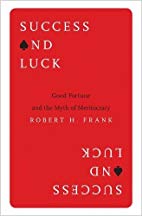
Success and Luck: Good Fortune and the Myth of Meritocracy by Robert H. Frank

This was two totally separate books barely hinged together. Part of it is: luck plays a very important role in success. The other part is: what we really need is a progressive consumption tax, to rein in wasteful spending that people only engage in because everyone else is doing it. I finished it, including the appendix that answers FAQ on the progressive consumption tax, and suddenly remembered, “Wait, the title of this is SUCCESS AND LUCK, what happened to that topic again?”
The loose hinge is that when people realize and acknowledge how big a role luck has played in their success, they become more generous and willing to accept more public spending… hence, we can push the progressive consumption tax, which we need for these other reasons. Get it? It’s loose.
I didn’t learn much from the success & luck part – I’ve already read Malcolm Gladwell. One takeaway is how depressing and non-motivating it is to acknowledge the role of luck; so from a mood perspective, we’re best adopting the following attitude: all my PAST success was due to luck, but all my FUTURE success will be due to effort.
I do want to note that the guy has got a wonderful skill at spinning his own attitude, based on this personal information he shared: he was an adoptee, and discovered in adulthood that the family that relinquished him was quite well-to-do, coming from old money. And he is THANKFUL, because if he’d grown up with a trust fund, he wouldn’t have made the effort to achieve any of the things that he ended up doing. That’s really something, being so grateful to have been given up for adoption into circumstances MORE needy than you would have otherwise. Hey, whatever works for you!


Book Corner

jeanLuceyPratt

A Notable Woman – the Romantic Journals of Jean Lucey Pratt

It somehow seems harsh to say that I didn’t really like this woman, after spending 600 pages with her, from her teenagerdom to her final ambulance ride at age 76…  But I didn’t like her, particularly in her 20s and 30s.  She was man-crazy and felt that women were incomplete without marriage.  I had been expecting the sexual escapades of a strong single woman.  Jean has affairs mainly with married men who treat her abominably.  She’s dying to get married; her professed love of her independence and fantasized regrets at losing it seem lip-service, compared to the relentless drumbeat of longing, pining, cursing, wishing, hoping, for HIM to call.  And so, she wants to get married; what of it?  Does she DO anything to try to make that happen?  Sleeping with a succession of married men doesn’t seem to be a very efficient route to that version of happiness.
She becomes more tolerable as she enters her 40s.  (Maybe I am just more sympathetic to my own age group.)  She opens a book shop, and finally I see a glimpse of that strong independent woman I had hoped to read about.
It was funny how she kept daring to dream that someday, someone would read her diaries – her exact wish has come true.  But you’d think that if she really did have hopes for publication someday, she would have written herself up in a more flattering light, and done a better writing job in general – she actually WAS a professional, published author.
Why did I stick with it – well, she wasn’t hateful, just pathetic.  I was also interested not just in reading a single woman’s life story, but about life in the 20th century United Kingdom, including the war years.  Ultimately, I did nearly shed a tear at Jean’s death – I had spent a LOT of time with her by the end; and it was strange, abrupt, unfair-seeming, to have her carried off after her final entry, and declared dead some weeks later.  “But that can’t be all,” one somehow feels… “She can’t be just… gone?”  Like in real life.  😦

On Having Two Dead Parents

I came across a written passage yesterday, which was a thought I see written from time to time: that once you have two dead parents, the feeling of mortality weighs down on you in a new way, because you are “next in line.”  I never feel that way.  I feel a lot of things about having two dead parents, but a heavier sense of my own mortality isn’t one of them.  It feels kind of like the illogic of thinking two coin tosses of “heads” in a row increases your chances of “tails” on the next throw.  We can any of us die at any time.  Just because both my parents somewhat recently landed “heads” doesn’t make my ”tails” any more imminent.

What I feel most about having two dead parents is freedom, and not just the freedom to spend Thanxgiving any way I please from now on.  Two relationships that defined me whether I liked it or not, and I didn’t, no longer define me.  Now I’m just me.  And my siblings, the relationships that bound us together, child to parent and parent to another child, no longer exist.  Now we’re just three adults.  All of that drama, it’s over.  And more than that, there are no more excuses, either.  Blame your parents for 50 years if you like, but there’s got to come a time when the ridiculousness of that can no longer escape even you.  I had my chance to be molded and shaped and deformed and stunted and held back and warped and all that.  It’s been done, it’s over.  Now I’m just me, just a pushing-50-year-old woman, “I yam what I yam”.  Not that life is over and I won’t “grow” or develop any further; I hope to.  But it is now in my hands entirely, to a new extent.

And speaking of pushing 50, there is an anonymity to this age about which I’ve also read strange things from time to time: that a woman of a certain middle age and beyond becomes in a sense “invisible.”  Men on the street no longer see her as a sexual possibility, and so they don’t “see” her at all; likewise younger women, who no longer see her as sexual competition.  This too feels very freeing to me.  I’ve always WANTED anonymity.  As a very young adult, I felt happiest sitting on a NYC subway car, surrounded by every variety of humanity you could imagine.  Back in high school, back in Staten Island, I felt I stuck out all the time, a hideous thing full of acne.  On the subway, nobody gave a shit about the girl with the acne; she was one of the less interesting and gruesome things around.  I loved it.  I never wanted to be noticed.  I always wore things to tone down my bright red hair, not draw attention to it.

For others, relationships are ‘primary’; for me, they’re not even secondary.  All I’ve ever wanted to do is my own shit.  Now I can drift through life unnoticed and unimpeded more than ever before, and just do my own shit.  Finally.