Book Corner 2019.12

atheism

The Seven Types of Atheism by John Gray

I liked this book for its main idea, more than for its writing or details, which frankly were often over my head.


The main idea is one I’ve tried to fully form in my head many a time, about progress being a myth. Gray argues here that much of modern atheism, notably secular humanism, is wholly religious in nature, and owes its existence to monotheism and Christianity.


Prior to Christianity, so it goes, the ancients had no concept of a grand narrative of human progress. Things were seen as cyclical.  Humans progressed, and then fell back as often as not.  Knowledge was gained and lost.  There was nothing new under the sun.


Pow! Here comes Christianity.  Now history becomes a story of before and after, human striving serving an ultimate purpose.


Whereas Christianity is what lent humanity the idea of salvation and progression, what monotheism brought to the table was universalism. No longer would I worship my local gods and you yours; not even would it be the case that I would worship my “God” and you yours.  No, now there was ONLY ONE god – for EVERYONE.  From here arose the tendency of humans not just to conquer, not just to impose their physical will on others, but to insist on imposing their very morality and religion on others, which was something new.


There is a lot in this book about the religious nature of so-called atheistic movements – Bolshevism, Naziism, and lots of obscure movements and tyrants that I for one don’t think I had ever heard of – “Bockelson” or “John of Leiden,” for example, an Anabaptist from the 16th century, made for a particularly gruesome digression. Gray seems to almost delight in ticking off atrocities committed throughout the ages by the religious and allegedly areligious alike.  I could have done without it.


This world view of life as cyclical and non-improving is one that resonates with me, and though I usually think of it on the micro rather than macro scale, it seems to fit the facts well enough on both levels. I feel exactly like the four-year-old child I once was.  True, I used to be two feet tall, and now I am five foot four.  Is that “progress”?  I am better now at follow spelling rules.  I’ve amassed some knowledge.  Progress can only be proven on trivial levels such as this.  In so many more senses, I am the same.


Similarly, you cannot deny that humans own more cell phones now than ever before, certainly more than in the 15th century.  It’s a fact.  Is that progress?  We’ve managed to amass technical knowledge, and not yet lose it, though there is no guarantee we won’t lose it all somewhere down the line.  But despots and intolerance continue to rule as much of the globe as they ever did.  I won’t bog down in a scorecard of what ways we’ve progressed and what ways we haven’t – ultimately, I’m not here to convert you, and neither is Gray.  One of the types of atheism he semi-ridicules is that which does nothing but position itself in opposition to religion.  Religion is part of human nature; why single it out for opposition?  Science and religion are not opposites or opposed to each other any more than are science and art.  Do scientists seek to stamp out art?  Why not?  So, why try to stamp out religion?  Think about it.  And if you are a secular humanist, and your “religion” is that of human progress, then good for you.  Different people can have different religions and moralities.  We very likely need them, and have them for a purpose.


Book Corner 2019.11

1501133098_01__SX142_SY224_SCLZZZZZZZ_.jpg

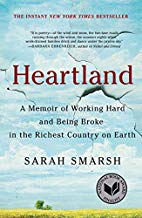
Heartland by Sarah Smarsh

I can’t be objective about this book. It’s a memoir by someone born unwanted to an unwed teenage mother, who grew up in & around Wichita.  I was born to an unwed teenage mother, and I spent a year or so in my late teens with the weirdest determination to move with my boyfriend from Staten Island to Wichita.  Hence this book was like a weird mash-up of the kind of life I could have had, poor and disadvantaged, had I not been relinquished; and the life I briefly but badly wanted to have, canning vegetables in a farmhouse in Kansas.

So, that said, let’s try to be objective. It may seem at first blush that we have yet another GLASS CASTLE on our hands – look at my crazy childhood!  Marvel at my wherewithal as I escape it!  But this is one “growing up poor” memoir that is definitely different.  Smarsh addresses the whole thing to “you” – “you” is the baby she never had; the unwanted, unwed pregnancy that would have sealed her fate, like that of her mother and grandmother before her, had she not made it her teenage life’s goal to graduate with a diploma in hand and no baby inside of her.

Furthermore, Smarsh doesn’t play her childhood for shock value. All of the main characters in her life are viewed with compassion.  In fact, the book is more like HILLBILLY ELEGY than GLASS CASTLE; but HILLBILLY wasn’t political at all compared to this.  Smarsh puts no blame whatsoever on any of her relatives for their actions; she blames everything on poverty, and poverty she blames on our flawed American system.

She has no policy prescriptions, and it’s not clear what she would advocate to fix things. Her relatives eschew handouts and help, and wouldn’t accept increased (or any) welfare payments if they were offered, so increasing traditional poverty relief programs won’t help.  What Smarsh seems to want is an admission – from somewhere, somehow – that the American Dream is a hoax.  Working hard DOESN’T help.  And then, I guess, we take it from there?

I can see whence she gets this – by all accounts, her folks DID work hard, and DO work hard. I lost track of the number of truck stops opened by the females and jobs held down by her Dad.  And I’m not seeing incapacitating addiction, other than by Dad’s new wife, or too many other horrendous life decisions; apart from too much husband-hopping and, of course, the unwanted pregnancies, these being where Smarsh lays the blame from Day 1, being one of them herself.  Her family is Catholic, so I guess that’s why contraception is not mentioned even one time throughout the entire book that I can remember.  (Smarsh stays unfertilized by choosing a boyfriend with no “physical desire” for her – she drops this strange fact at the end of the book, never having mentioned a boyfriend before, which was bizarre.)  It is odd to me how Catholics can apparently take the no-contraception rule so incredibly seriously, but not pay any respect to certain other rules, such as, oh, say, the one about marriage vows.

As a writer, Smarsh occasionally gets repetitive, as well as coming off as whiny. A big plot point is her mother’s ambivalence toward her.  She gives us very few actual examples, none of which is earth-shattering; though maybe I’m just inured to such things by the whole GLASS CASTLE genre.  The narrative also does not seem directly chronological, and gets confusing.  Apart from the names of her mother, grandmother, and great-grandmother, names of other relatives could get hard to keep straight, especially due to the overlapping ages of the generations due to the unplanned timing of pregnancies; but Smarsh does drop reminders reasonably often (“my young aunt”, etc.).

I wanted to return to this story again and again… maybe, in the end, mostly due to my personal reasons. I’m so happy I discovered it.


Book Corner 2019.10

1594634807_01__SX142_SY224_SCLZZZZZZZ_

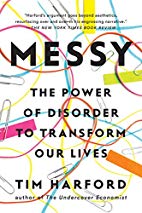
Messy by Tim Harford

This book’s cover features blurbs by Brian Eno and Tyler Cowen.  Otherwise, I never would have thought this was a book I’d enjoy.  I fall on the ‘tidy’ end of the spectrum.  I didn’t want to read a book about how the most awesome, brilliant, and creative people in the world all have/had sloppy desks.  Not only is it not my world – it tends to be a boring kind of book.

But – despite the requisite chapters about sloppy desks and messy workplaces, this book isn’t about how you really should dis-organize your space so much as it’s about the sometimes (!) beneficial effects of disorder in general.  The first chapter on Brian Eno’s “Oblique Strategies” sets the tone; to get people to be more creative and motivated in the studio, Eno created a deck of cards with suggestions of off-the-wall things to think about or do.  He’d periodically pick a card, and suddenly everyone was instructed to try to “Think like a gardener,” or all trade instruments.

There’s a chapter about a crazy military commander or two, who’d keep the enemy – and sometimes their own men – just bewildered enough to allow the most improbable victories to be snatched from the jaws of defeat.  There’s a chapter about the famous “Building 20” at MIT, an ugly pile of cinderblocks with an unorganized disarray of offices, which nevertheless was a hotbed of scientific discovery and invention in the 20th century.

So it isn’t about dividing people into messy vs. neat, so much as it’s about how helpful it can often be when things DON’T follow the expected path.  Harford encourages us to appreciate rather than rue the Oscar Madison that lives in all of us.  Some (!) disorder is good for you; it shakes you up; you function better; it’s real life.  The book flowed well (dare I say it was well organized?); I always looked forward to returning to it each day.  I’m a fan!

Book Corner 2019.09

1439190739_01__SX142_SY224_SCLZZZZZZZ_

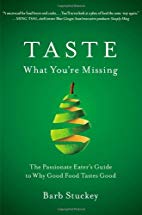
Taste What You’re Missing by Barb Stuckey

This was fun.  It is full of little “science experiments,” however, that might interest your eighth grader, but just get annoying to page through.  They are along the lines of, “Puree different foods and add food coloring to make them all the same color, and put them in unlabeled jars.  Hold your nose and taste them. Can you tell the difference?”  Not very profound.

The takeaway: Slow down for Pete’s sake!  Eat every bite with rapt attention.  She’s a food lover.  Her perspective is an interesting one, too: she isn’t a chef or scientist, but works in the food industry, making food taste better.  Yup, adding aromas and artificial flavors – she doesn’t go into what distinguishes ‘natural’ from ‘artificial’ flavors, unfortunately.

So, bottom line, I could have learned more.  But there were some share-worthy anecdotes along the way, and reading about food from a food lover is always the next best thing to eating food!

February Dreaming

Items
Provider
Red Swan Bush Bean
Cylindra Beet
Napoli F1 Carrot
Dwarf Green Curled Kale
Breen
PLS 14 Shelling Pea
Cider Jack F1 Pumpkin
Schwarzer Runder Radish
Ronde de N. Summer Squash
Orangeti F1 Winter Squash
Matt’s Wild Cherry Tomato
County Fair Blend Zinnias
Dwarf Jewel Bl Nasturtium

Might As Well Face It

We are addicted to Sudoku.  Black pens, colored pens, white-out pens litter our house like junkies’ needles; grids and worksheets foul every surface.  There’s Sudoku in the Burlington Freeps & Sudoku in the Seven Days – we scrounge every one we can lay our inky hands on; buying books isn’t enough to satisfy our cravings.  Xopher no longer surfs the internet; my fiber equipment lies unused.  It’s Sudoku, Sudoku, Sudoku, broken up only the occasional sumoku, calcoku, or kenken.  Stay tuned for the inevitable journal of recovery: “Off the Grid: My Year Without Sudoku”, coming soon.