
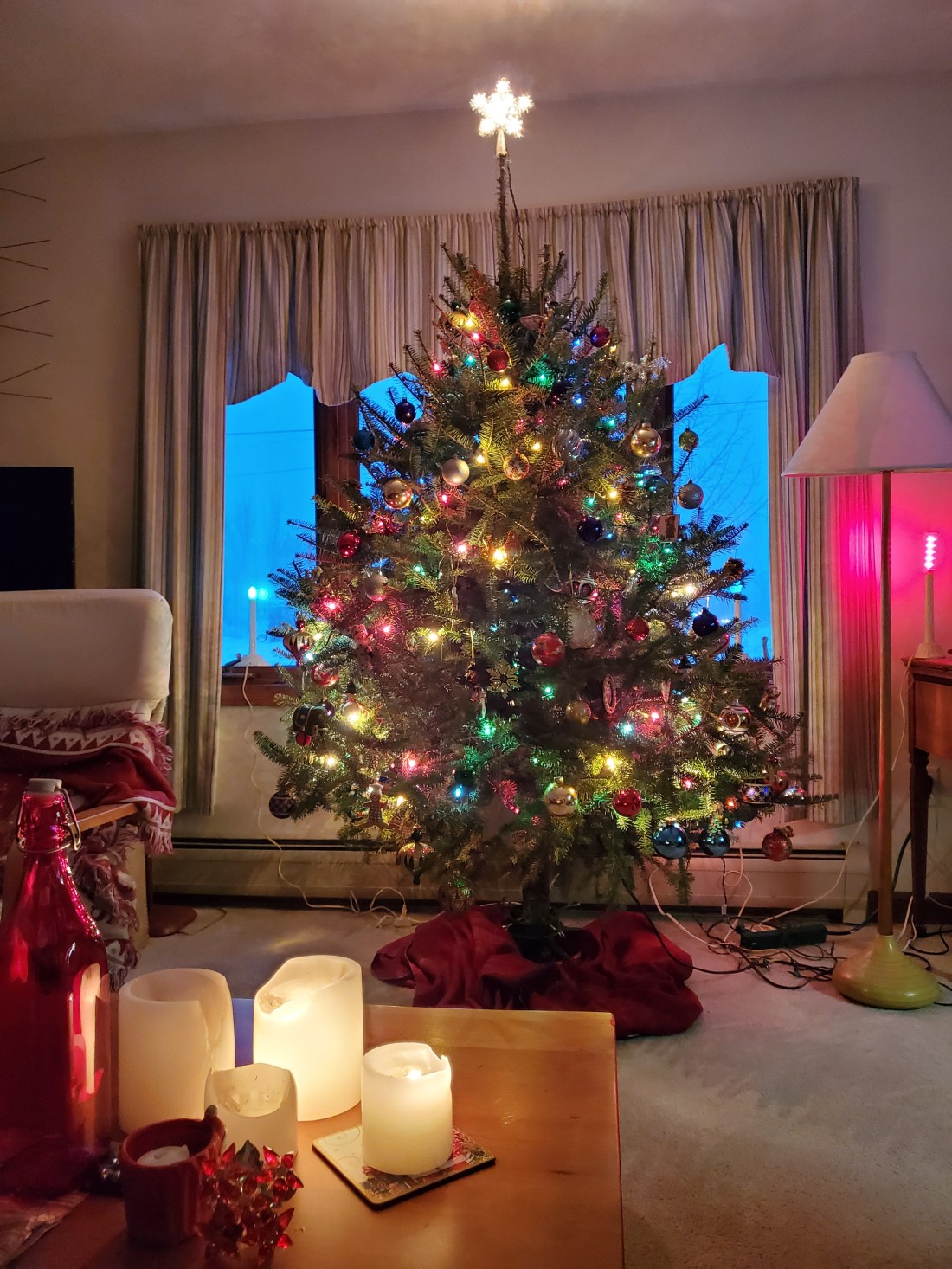
Last weekend of tree – Epiphany is Monday.
Cheers for beauty.
Last weekend of tree – Epiphany is Monday.
Cheers for beauty.
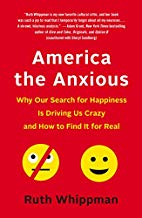
American the Anxious by Ruth Whippman
Started out strong, and had a hysterical, dead-on chapter about meditation, or as Ruth puts it, “Meh”-ditation. The theme really isn’t about how Americans are too anxious; but about the ridiculousness of the happiness quest and its associated industry. Ruth’s discovery seems to be that happiness is other people. I beg to differ, but I still cheered on her take-down of mindfulness.
Unfortunately it frequently devolved into that kind of non-fiction book I hate, the kind that reads like a research paper. “Research shows this. It seems that that. Turns out that…” And chapters about parenthood and Facebook were boring, with nothing we haven’t heard a zillion times.
Even amidst all of that, though, I still found myself frequently laughing out loud – not just chortling but outright guffawing. Maybe it’s the Britishness of her humor. (  )
)
I read 57 books in 2019. Thanx to Tyler Cowan, who taught me to discard with abandon books I start but end up not enjoying. Read only what makes you really excited to get back to your book, and you’ll make the time to get back to your book. And have a better time when you do.
Best fiction discovery: Lionel Shriver. I discovered her starting with The Mandibles and ended up reading four more, my favorite probably being We Need to Talk About Kevin for its sheer staying power, closely followed by the Post-Birthday World. I really love parallel universes. So Much for All That would have been another favorite were it contained to the main plot, and had it discarded with the subplot.
Best non-fiction discovery: Meghan Daum. She writes essays that just talk out of my own brain. See: the Unspeakable; this year’s Problem with Everything. Some of Life Would Be Perfect If I Lived in That House also resonated. She has also written a novel, the Quality of Life Report, which I read years ago before I knew she was herself.
What happened in my life this year that didn’t take place on my couch under the reading lamp? I turned 50, obviously, and got some clean medical screenings. My spouse and I greatly enjoyed 2 weeks in coastal Maine. A new mudroom was completed on the back of our house. All of this could have been predicted; the real wild dominoes fell at my job. My manager experienced a life-changing injury in late February; and [the product that I work on] experienced a 6-hour outage on April Fool’s Day. As a result, one of my best work-pals is now my boss, and we haven’t done any meaningful work since April. You just never know.
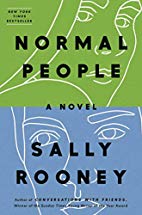
Normal People by Sally Rooney
The first part was excellent. Marianne is a high school outcast who barely registers, let alone cares, that she is an outcast. Connell is a well-liked, smart and athletic boy who is nevertheless awkward and introspective. Marianne is part of a rich family, and Connell is the son of their housecleaner. They begin a sexual relationship, which they keep secret. The secrecy is not because Marianne is associating with a working-class boy beneath her station; it’s ironically because Connell is dallying beneath his station in the high school popularity pecking order. Small spoiler for part one: Connell finds out after high school is over that a) everyone at school kind of knew all along about the relationship, and b) now that high school is over, it doesn’t matter at all that he was seeing Marianne, because that whole part of life is over. So all the secrecy was for nothing, and this hits him hard, because he knows he should have done better by her.
After that, the story seems to thrive on misunderstandings and unspoken things between Marianne and Connell, who both attend Trinity College. It became a bit less interesting as Marianne turned out to be not so much a free-spirited iconoclast but a broken girl from an abusive home; Connell became the more interesting character. I’ll try to avoid spoilers by stopping here, but the ending wasn’t bad. (  )
)
I can almost feel my brain atrophy here in North Carolina with my in-laws.
I want to go home and never leave.
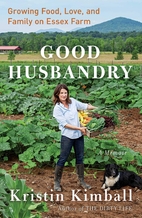
Good Husbandry by Kristin Kimball
Having first met Kristin Kimball in THE DIRTY LIFE, we follow up now to see how her marriage to Mark and Essex Farm are doing.
Well, one observation of hers that I liked was an interesting angle on the by-now over-observed ‘curated’ nature of our lives today. Someday, she said, future generations will look back on how we only showed a positive picture of our personal lives, and marvel at what a load of shit it was, the way we look back at the Victorians and their ostensibly prudish mores and know that they got down and did the nasty just like every other generation.
So Kimball purports to pull back the curtain a bit and show us some of the miserable bits of existence on a farm with a nutjob husband who wants to dress the kids in sacks. But of course, overall the, arc of the book has to bend towards positivity, or else it wouldn’t be a product of its time; or else, nobody in this time would want to read it.
The second kid they have basically wrecks everything. Kimball starts to feel separated from the farm and its work and from Mark as she spends all her time taking care of babies and cooking.
It’s so easy to see the solutions to other people’s problems – that’s why I like reading advice columns so much. I wanted to shout, YOU’RE DOING TOO MUCH. Why do you guys think you have to fee the entire town? Feed yourselves – and a few extra people as gravy! You can do that easy! At no time or place in history did an entire town get fed from a single freaking farm. What on earth do you think you’re trying to do?
As for the martial problems, I wanted to shout: is Kristen a partner in this farm business or is she a hired hand? If she’s a partner, why can’t she decide to spend a few dollars improving a room in the house, or taking a freaking afternoon off to go to Plattsburgh – with the kids, to buy a piece of plumbing equipment for chirssakes – it’s not like she even wanted to go there to buy shoes, although that should have been perfectly acceptable too. You know, world, not every physical step taken in a marriage has to be we, we, we.
I really liked DIRTY LIFE and I still like reading Kimball because I share her feelings about growing and cooking food. I envied the meals she described making – not because they sounded so delicious, though I’m sure they were, or creative or anything, but because they were all so hard-earned, which is its own special sauce. Some people aim to work hard and play hard. I wish I could work hard and eat hard. I really like that about vacations where we bike & hike – I like basically wrecking our bodies all day so we can just fill them up with abandon at the end.
Anyway as we feel Kimball’s worry and read about their privation through hardships and setbacks on the farm, only towards the end of the book does she mention the help they got from a royalty check from her first book. It made me conk myself on the head and say, oh yeah, there is that. They did have an alternate potential source of income this whole time, which she never mentions – she’s a writer. They aren’t only holding on by their fingernails on the farm.
One last observation is about how they struggled with flooding; their farm is low-lying and they had no drainage until some weirdo in town decided to voluntarily finance it for them out of the blue. She touches on the realization that the ‘bad’ years of wetness actually were outnumbering the ‘good’ years, and it takes years for people to slowly realize that a particular piece of land or region of the country maybe isn’t all that suited to what they envisioned doing with it during an odd beautiful year. Reminds me of an old quote I read about early white settlers in New England, to the effect of, “When I think of the glowing pictures of this place that they wrote to us back home, I can only think, they must have been writing during strawberry time.”
In the end things started looking up for Essex Farm. Key things seemed to be the book royalties, and opening up their market to the rich weirdoes in NYC. Yay rich weirdoes.


Goals 2020:
Things not part of my mission in life:
In Pieces by Sally Field
I read this only because it was a book club pick. I do enjoy almost all memoirs; and this did have a good narrative arc, watching Field’s acting career progress in “seriousness”. But I never would have picked this book on my own, mainly because, I really just don’t care about actors. I don’t find acting interesting as an art, and I don’t find actors intrinsically interesting as people. And I had a hard time nailing down who exactly Sally Field was. Funny true story – when we were considering doing this book, someone in book club said that Sally Field was “so good in ‘All in the Family.'” After some puzzlement, we all protested, “That was Sally Struthers!” Then someone added, “Yes, Sally Field was Coal Miner’s Daughter.” Then we all protested, “No, that was Sissy Spacek!” And I’m really embarrassed that I went home chuckling at this, and then read the book the whole time waiting for her to get to her big break playing Major Houlihan in the movie version of M*A*S*H. That, of course was, Sally Kellerman!
But seriously, I think I’ve at least got straight now who Sally Field is and was. She was Gidget, then the Flying Nun. She enjoyed being Gidget but hated every moment of the Flying Nun, and longed to be seen as a serious actor. The book climaxes effectively with her winning the Academy Award for ‘Norma Rae’.
Of course, there’s abuse along the way. Field’s childhood was dominated by sexual abuse by her slimy stepfather while her drunk mother looked the other way. I’m glad she seems to have achieved some degree of closure on those issues by book’s end. ( )
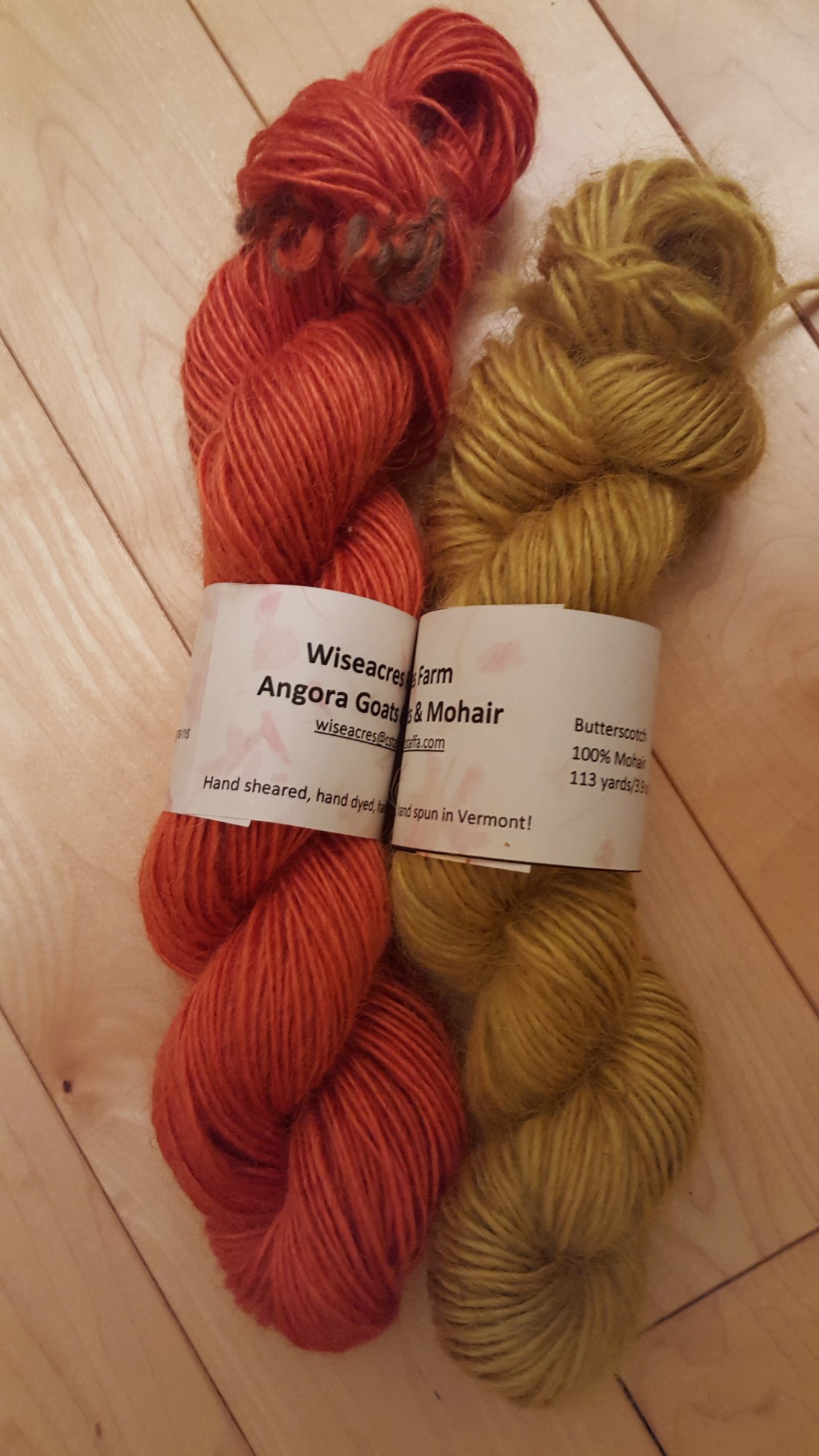
Butterscotch joins Damn! That’s Orange to make a total of TWO yarns in my Winter 2020 Yarn Fleet.
The prep goes so much faster when working with fairly choice mohair and not dregs left over after consignment – that’s another great benefit of me holding onto all my fair leftovers. So many nice locks to grab, as opposed to picking up piece after piece trying mostly in vain to find something not matted or full of scurf.
I learned the word “scurf” from one of my many Pretty But Useless fiber periodicals this week. Now I have a name for the waxy globs that some goats get at the base of their hair when they’ve been struggling with lice. It’s a bane.


Stuck in for work, makes a good day to dye.
Shave ‘Em to Save ‘Em Tunis fiber, in a bath of 80% orange to 20% blue.
“Looks poopy” said X. Does not.
 Tytania