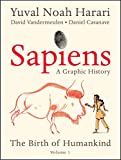
Considering the fact that SAPIENS by Yuval Noah Harari was one of the best books I have read, EVER, I expected to love this graphical interpretation at least a little a bit. A problem is that I tend to be annoyed by graphic novels. They feel gimmicky. And this one was high on gimmick factor. It didn’t just illustrate Harari’s ideas… it introduced a young inquisitive niece character, Zoe; and an obese Indian woman scientist who carried a small dog everywhere. I honestly have no idea why. Any of it.
Most of the time I felt the book was at the level of the Zoe character – for children; older, genuinely science-curious children, but still… children. (Notwithstanding lots of nudity.) I kept wondering what I was getting out of it.
But in the end – though it seems I always have to spend a lot of any review being a nattering nabob of negativity – I DID get things out of it. It made me think about us all being animals… evolving from and with animals… animals, our brothers, our OLDER brothers, as I read in another scientific book of a different stripe recently, BRAIDING SWEETGRASS. Here in the graphic SAPIENS, the pictures did add something more than a gimmick, I have to admit: I remember a picture of a doe-eyed doe, and it made me think about being a nearly-evolved sapiens looking that doe in the eye, as an equal.
Another idea still persisting in my mind: “Our brains are still adapted for life as hunter-gatherers. Our eating habits, our conflicts, and our sexuality are all the result of our hunter-gatherer minds grappling with a post-industrial world.” I can’t be blamed for the fact that I simply cannot resist a plate of fries or a pie crust when they are sitting right in front of me. The hunter-gatherer in me would KILL – literally! – for that amount of delicious fat.
Also: One reason we can’t look at modern-day hunter-gatherers as a stand-in for what life was like for our early ancestors is that what’s left of today’s foragers are all living in the most marginal places. “Modern forager societies have mostly survived in regions with difficult climatic conditions, and inhospitable terrain that doesn’t lend itself to agriculture.” I’ve always tended to think of hunting-gathering with a big fat “No, thanx!” Agriculture is my favorite invention. When people talk about eating wild foodstuffs, it’s about as appealing to me as dumpster diving. Yay, a handful of fiddleheads, some mushrooms that hopefully don’t poison us; and maybe, if it is exactly the right time of year, some really seedy blackberries! Sounds WONDERFUL! Please, bring on the agriculture already.
But the hunter-gatherers in pre-agricultural times weren’t all trying to make a living on my 3 acres in Vermont. Think about our most fertile agricultural land, our most abundant seacoasts and forests. They lived in the good places. I’m not saying food was as thick on the ground as it is in your intensively cultivated plot of garden, maybe; but then again, maybe it wasn’t far from it, either.
They lived in the good places, and they lived all over the world. Before agriculture, think about it – we were already everywhere. We had an abundance of lifestyles and cultures, just like today. We just didn’t live in towns, or on farms. We all just lived on the land. Like the animals. Because that’s what we are. ( )
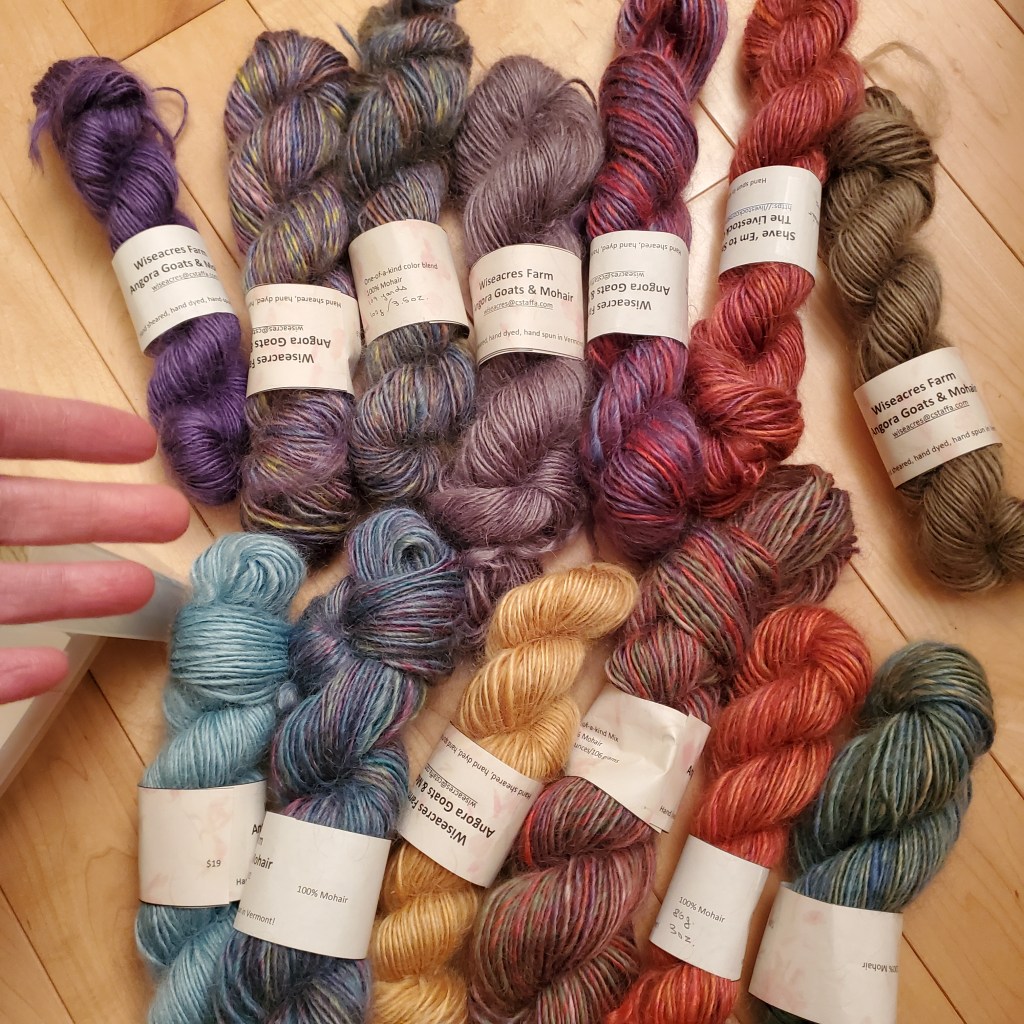
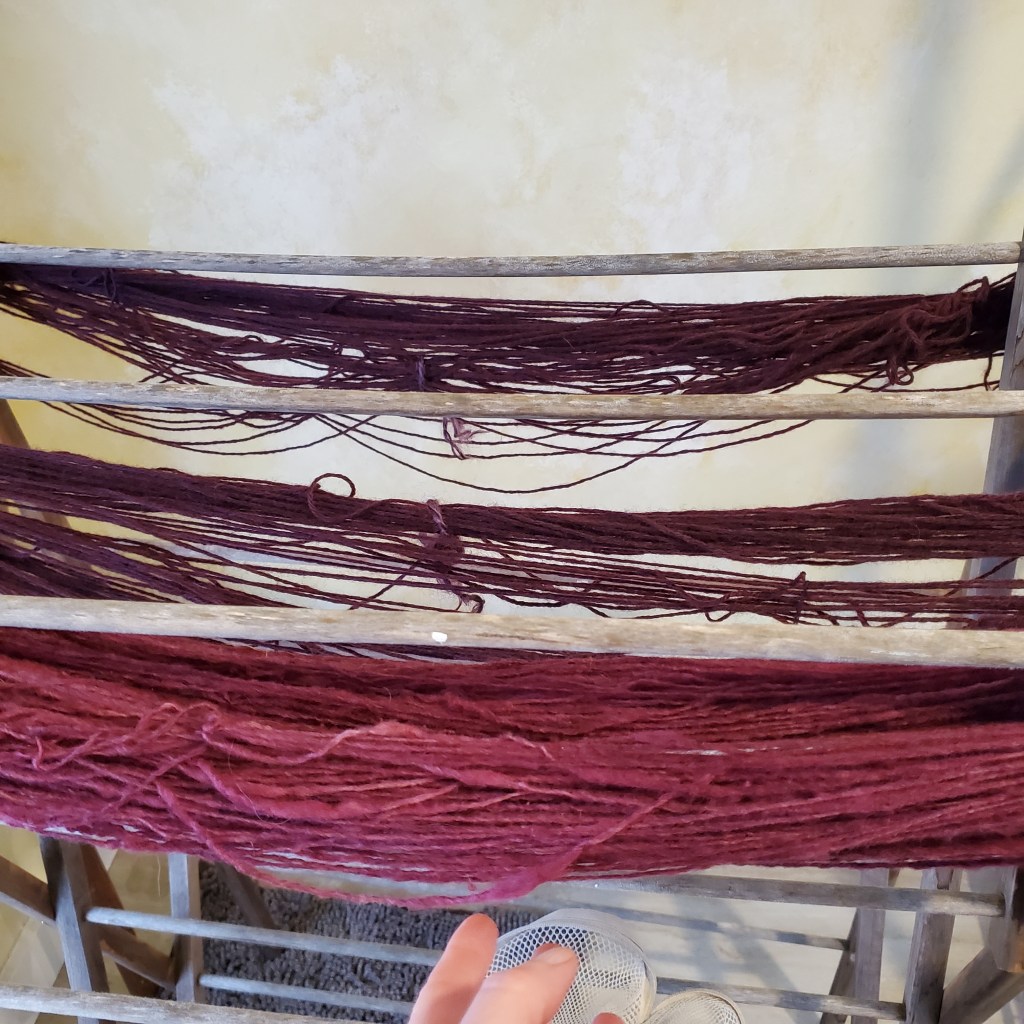
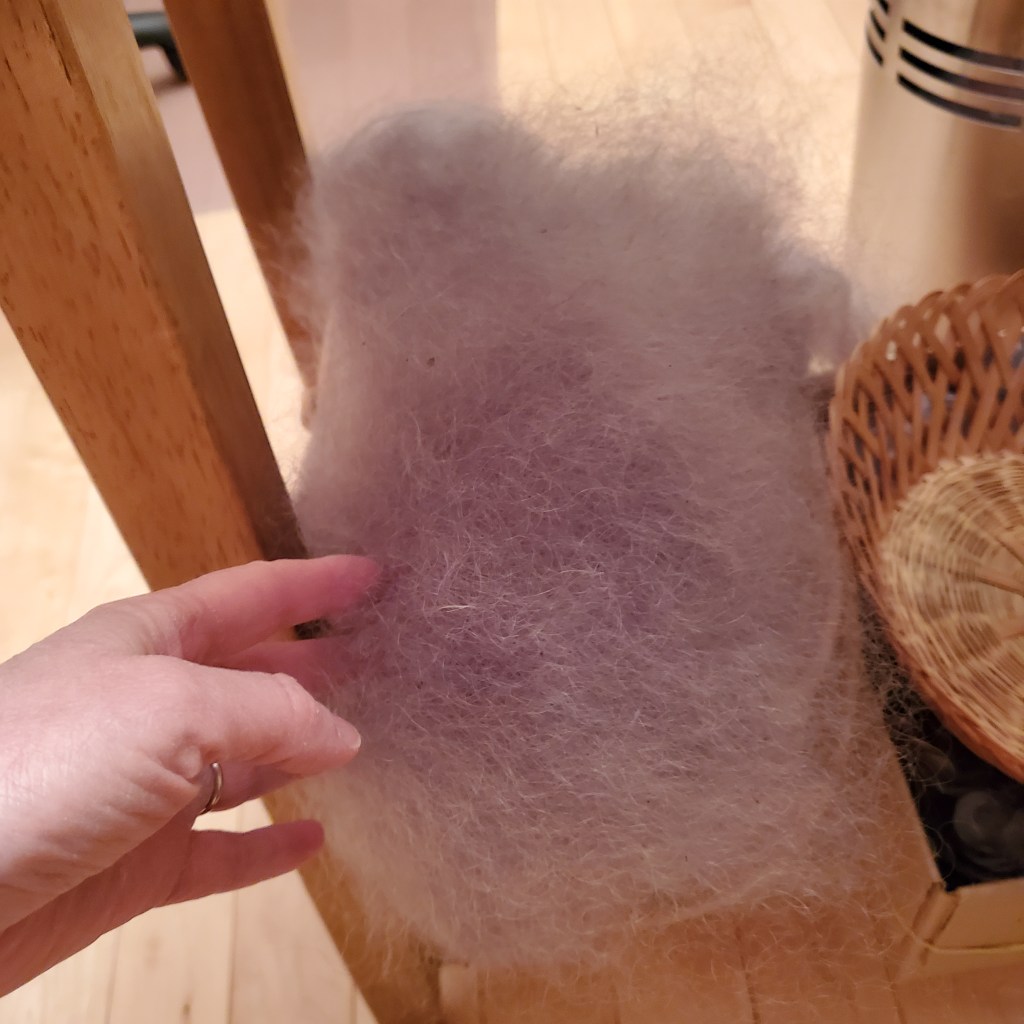
Dyed with Cushing “Burgundy.” The stuff in the back is Knit Pix originally a khaki color. I overguessed how much dye I needed, so the stuff in the front is some white handspun I threw in to soak it up.
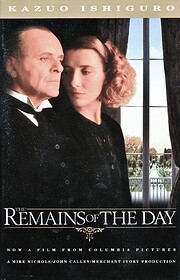
I don’t remember if I saw the movie. I don’t think I did. Yet I picture the characters perfectly as Anthony Hopkins and Emma Thompson. Not only because they are on the cover. The parts just seem made for them.
“Every life contains millions of decisions. Some big, some small. But every time one decision is taken over another, the outcomes differ. An irreversible variation occurs, which in turn leads to further variations. The books are portals to all the lives you could be living.”
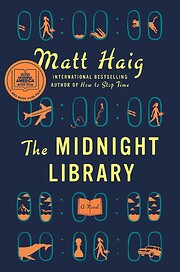
Thus the premise of THE MIDNIGHT LIBRARY. Nora hovers between life & death, and is given the opportunity to explore the books in the eponymous library, and live bits of some of the other lives she could have lived.
“You do realize there are infinite possibilities here?” says a fellow traveler. “… It’s not about a million or a billion or a trillion universes. It’s about an infinite number of universes. Even with you in them… [T]his is an opportunity and it is rare and we can undo any mistake we made, live any life we want. Any life. Dream big… You can be anything you want to be. Because in one life, you are.”
But the real lesson:
“[M]aybe there are no easy paths. There are just paths… And we spend so much time wishing our lives were different, comparing ourselves to other people & other versions of ourselves, when really most lives contain degrees of good & bad…
There are patterns to life… Rhythms. It is so easy, while trapped in just the one life, to imagine that times of sadness or tragedy or failure or fear are a result of that particular existence. That it is a by-product of living a certain way, rather than simply living. I mean, it would have made things a lot easier if we understood there was no way of living that could immunise you against sadness. & that sadness is intrinsically part of the fabric of happiness… But there is no life where you can be in a state of sheer happiness forever.” ( )
We studied the poem “If” in 8th grade and I didn’t care for it because the ending was so disappointing. “You’ll be a man, my son!” Well, I’m not a man, and I’m never going to be a man, so what do you have to say to ME, Mr. Kipling? Harumph…
I’m really fascinated by the poem now because it seems to explain perfectly in two pages the entire philosophy of Stoicism, which draws me. So look out, here come my thoughts.
“If you can make one heap of all your winnings And risk it on one turn of pitch-and-toss, And lose, and start again at your beginnings And never breathe a word about your loss;”
This was referred to in a book I read about poker last year, The Biggest Bluff. Professional poker players never talk about really bad hands that they’ve been dealt, or streaks of bad hands. It’s… unprofessional. You can talk about it in the context of how you played, how others played; but to just bemoan how you didn’t see a single face card all night or something like that… you don’t talk about bad luck.
That’s what stoicism is about; not talking about your bad luck, or your good luck. It’s systems thinking, vs. goal thinking. Sorry, but Weight Watchers has always been the perfect illustration of this. Goal thinking: I’m going to lose 5 pounds! Systems thinking: I’m going to try to eat only 20 points each day this week. Goal people are always winning or losing. Systems people are winning all the time, because you win merely by following the system. Maybe you lose the 5 lbs, maybe not. (If not, you think about tweaking your system.)
This is another quote from “If” that Konnikova quoted in The Biggest Bluff:
“If you can meet with Triumph and Disaster And treat those two impostors just the same;”
Again, win or lose, you treat everything the same: you apply your system.
I’ve always been this way. I’ve always been lost without a system, and always clung to my systems, one of the earliest being Catholicism – if ever a religion was built for me, that was it, boy. Systems out the wazoo.
I tweak the quote a lot lately:
“If you can meet with Happiness and Despondence, And treat those two impostors just the same;”
It doesn’t matter if you’re “happy”. Apply your system.
“If you can meet with Good Sleep and Insomnia, And treat those two impostors just the same;”
It doesn’t matter how well you slept, ya dumbass, get up and live the day.
Why don’t the outcomes matter? Because they are beyond our control. This isn’t futility. This is acknowledging that the universe is determinant. And look out, here comes my Parallel Lives schtick – it’s related. There are infinitely many lives out there. Some of them are way better than yours and some way worse. But infinitely many… which means you can’t say where yours is on the continuum. Wherever it is, there are infinitely many better & infinitely many worse. There are some lives where you’re much fatter! Others, much thinner! And here you are.
It’s not a recipe for despair and futility – you still get up every day and apply your system (which may involve dieting, though I hope not). Because things still have causes, and sometimes you’ll effect good ones.
Back to Kipling… it’s funny to me that he seems to have a poem, “The Wishing Caps,” similar to but vastly inferior to “If”, which I’ll quote now:
“LIFE’S all getting and giving, I’ve only myself to give. What shall I do for a living? I’ve only one life to live. End it? I’ll not find another. Spend it? But how shall I best? Sure the wise plan is to live like a man And Luck may look after the rest! Largesse! Largesse, Fortune! Give or hold at your will. If I’ve no care for Fortune Fortune must follow me still.”
“Live like a man” – ugh, again, speaking to somebody obviously not me. But what are ya gonna do. Follow your system and luck look after the rest. Have no care for fortune – or, care painstakingly about it – either way, it follows you still, so why waste your energy?
I’m reading a novel right now about parallel lives, so you’re in for more of this.

 )
)