Looking forward to adding these blues and rich greens!

Looking forward to adding these blues and rich greens!
by Sofi Thanhauser
I want to give 5 stars to the chapter on wool and 3.5 to everything else. The chapter on linen I liked, because I just like hanging out with textiles and talk about old clothes; but as the first chapter, it falsely led me to believe this was going to be one of those non-fiction books that is just one well-researched fact after another. Instead, the next chapter, on cotton, was all about how terrible cotton is and has always been. That’s not my type of book either, but for a different reason. I don’t like just reading about how everything is awful, over and over. The chapter on silk was OK; but then, for synthetics, we get intensive details of various worker strikes earlier last century. I wanted to read a book about textiles, not the history of labor unions.
But then finally, WOOL! It’s interesting Thanhauser ordered her chapters the way she did; one would have expected the ‘primitive’ materials to come first and synthetics last; but I think she put wool last because it was the most positive chapter, where small mills and handcrafters save the day after all that nasty environmental damage and class warfare.
Thanhauser by the Wool chapter has proven herself a super-intelligent, serious researcher; so it was fun to see her discover my tribe of fiber-festival-goers and handspinners. She visits Fingerlakes Woolen Mill in New York, which could stand in for my own friends at Green Mountain Spinnery in Vermont or any of hundreds of small-scale mills we all know and love. She visits with people rescuing equipment from the now-defunct American Textile History Museum of Lowell, Mass. And she goes to “Woolfest” in Cockermouth, England. I was seriously planning to go to Woolfest in 2012, before familial hard times hit. It does indeed sound akin to the High Holydays experienced on this side of the pond at the New York Sheep & Wool Festival in Rhinebeck or (shout-out) the Vermont counterpart at Tunbridge. Alas, “I had to admit it [as do I]: Woolfest was a gathering of old women.” So many gray heads I counted while vending at Tunbridge. Not that there’s anything wrong with that!
Fun fact: the University of Wyoming created a Wool Department in 1907 and for a time was the only university to offer a PhD in wool. Imagine being a Doctor of Wool – I love it!
Someone’s stash I spotted a few days ago.
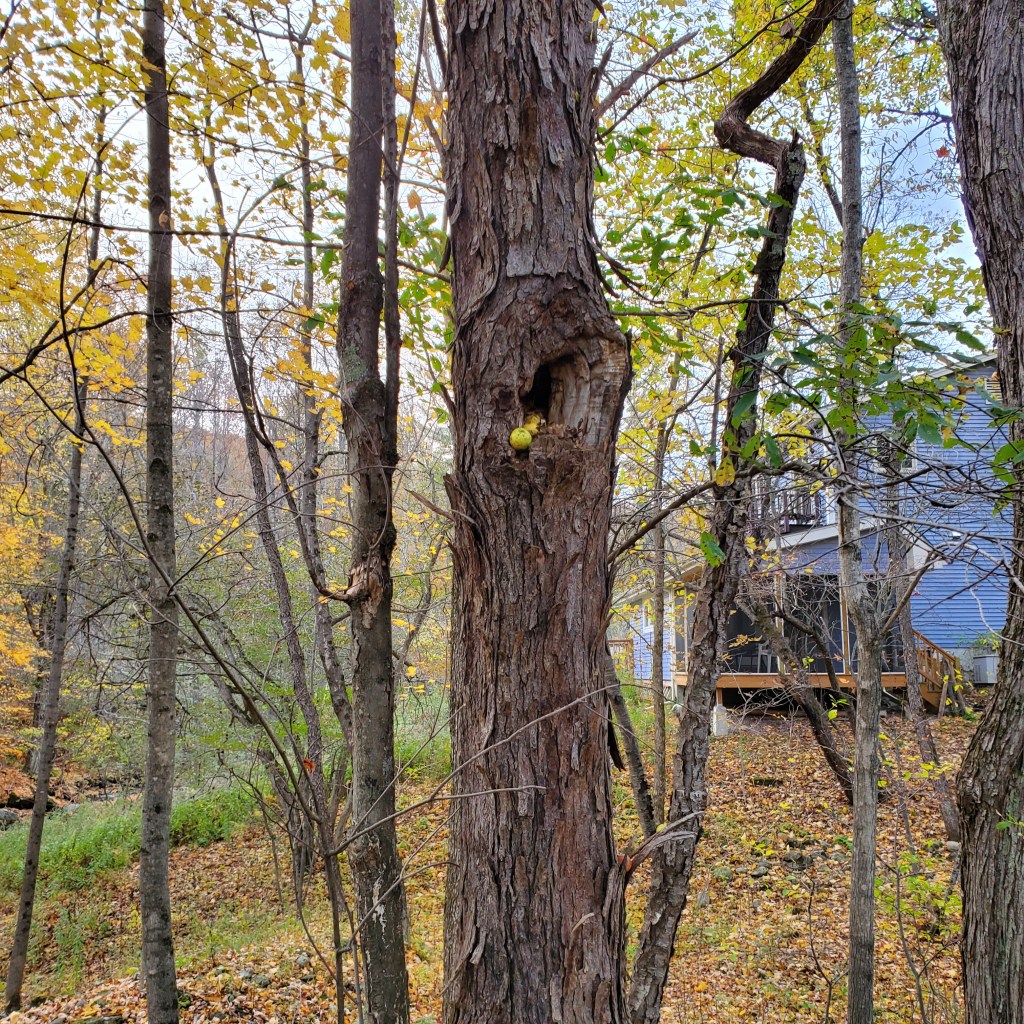

My shot for the town of Ira in my VT251 collection. Coming home from reunion today.
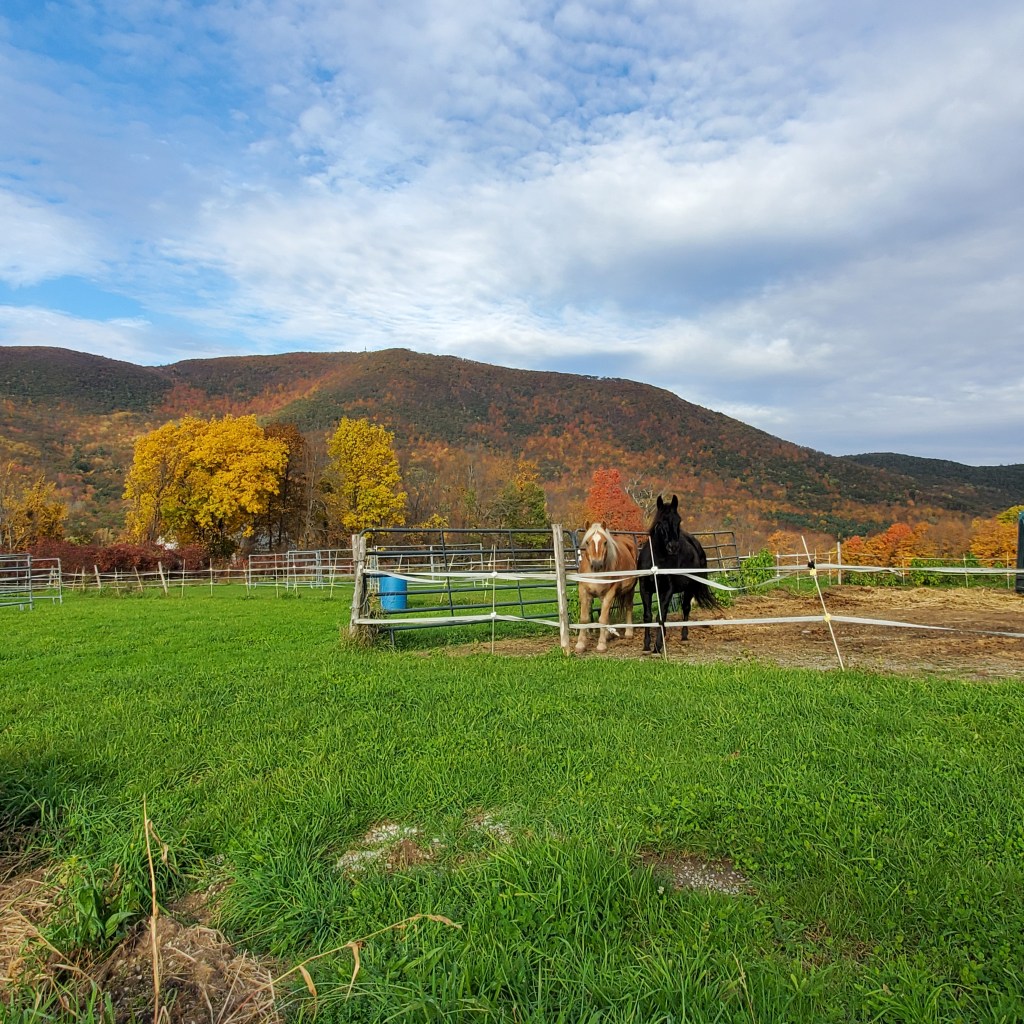
This foliage season just feels like a fireworks show with a finale that just won’t quit.
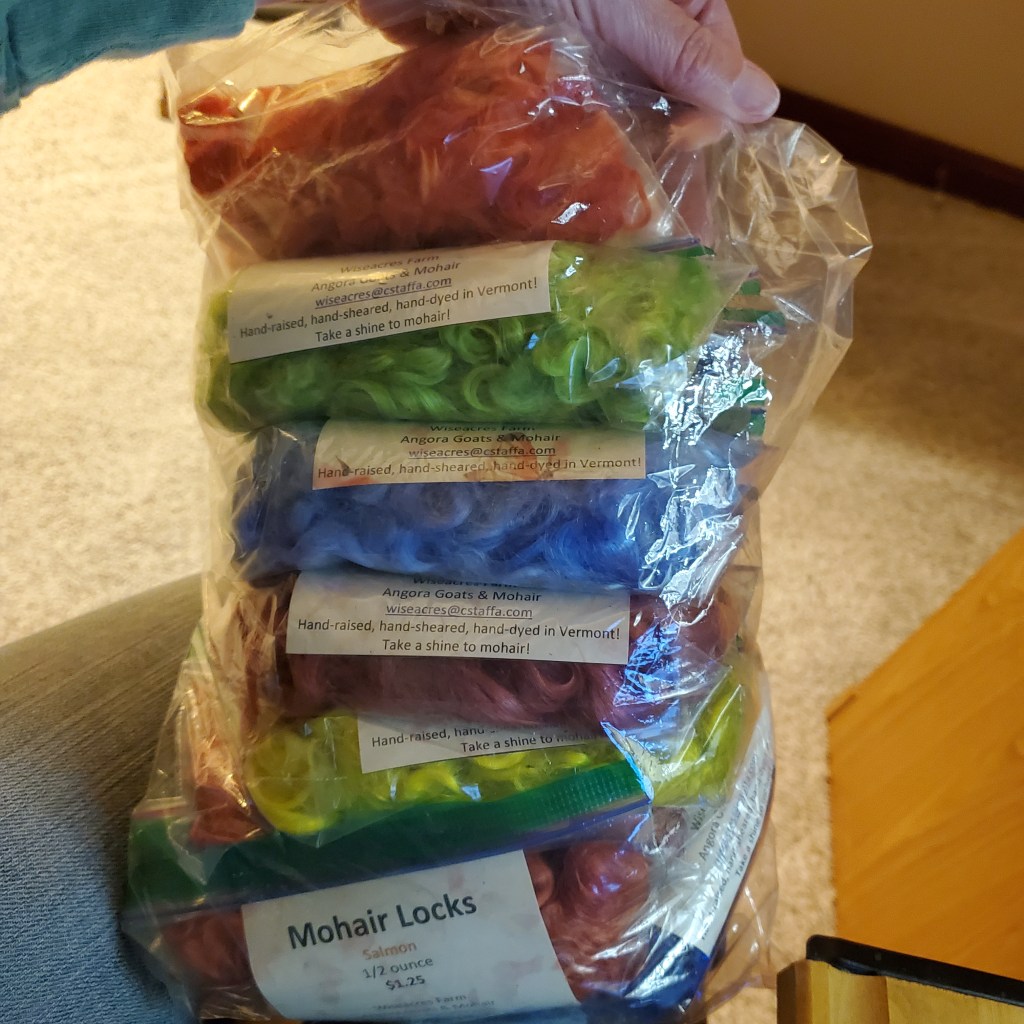
And another thing I’ve been doing is packaging bite-sized morsels of mohair for consignment.
Guess what, I found two boxes of locks dyed this summer that I totally overlooked for the Fair this year. I didn’t need to take up space with a “Grab Bag” box after all. Whatever! They were a brown, and yet another blue. They wouldn’t have been big sellers.
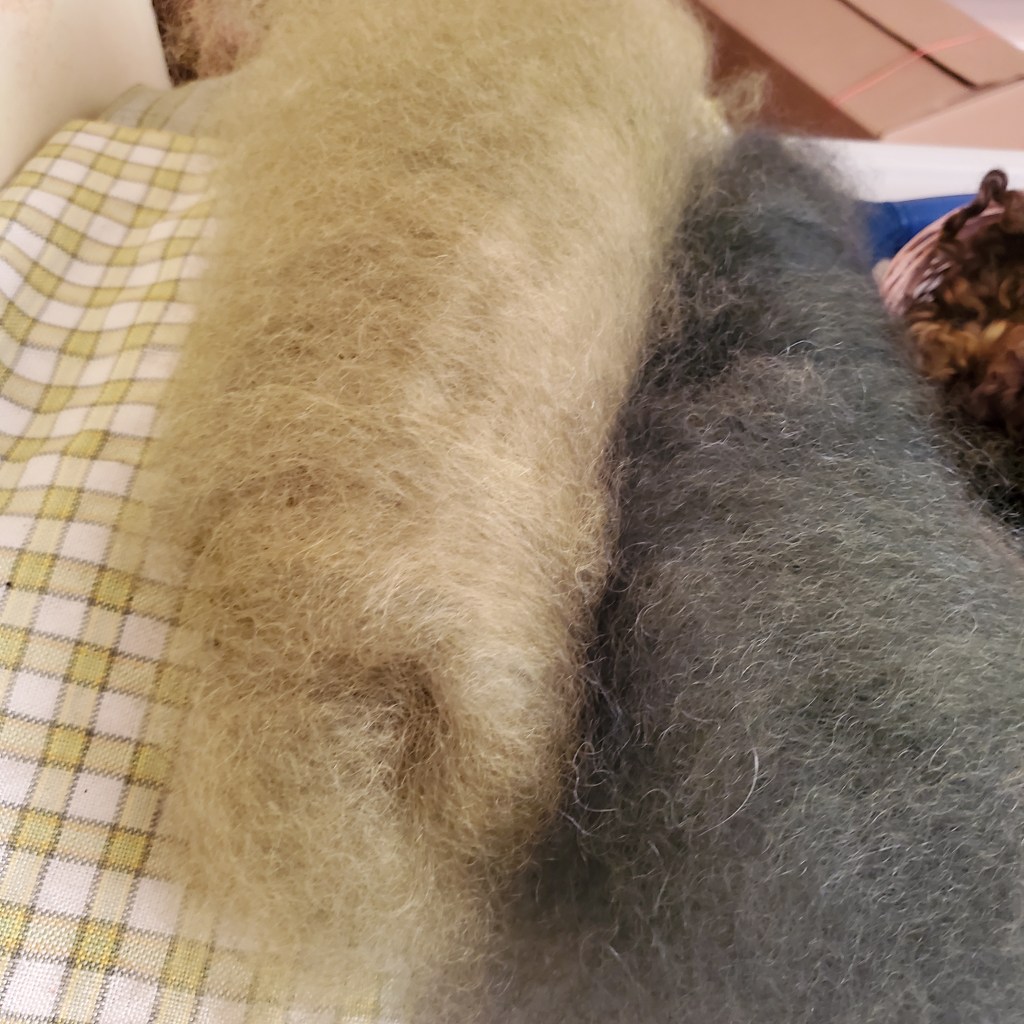
Feeling that the Evergreen and Wedgewood just didn’t provide enough contrast together, about a month ago I dyed a darker color, and soon embarked on a Redo. Reserve judgment till it’s done.
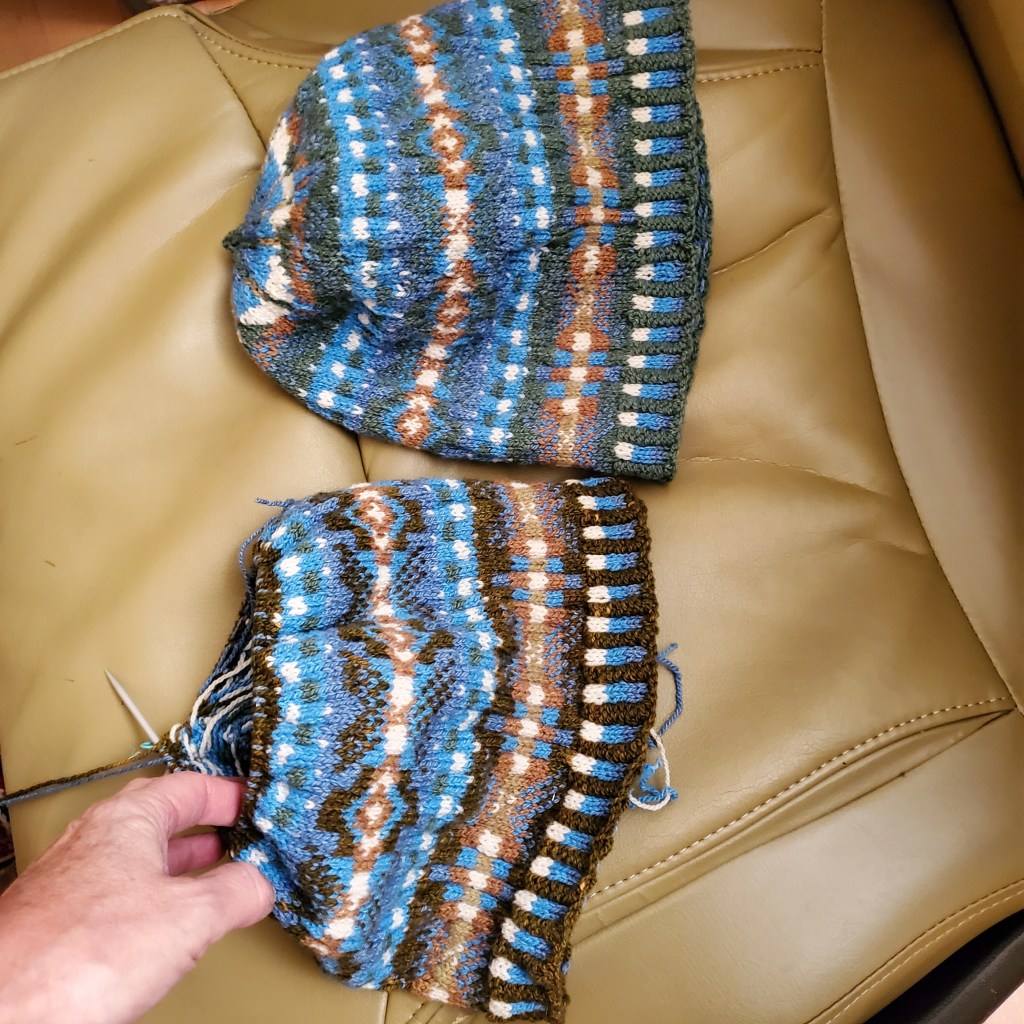
One of the things I’m doing at Playtime is working on these locks I fell hard for at the Fair:
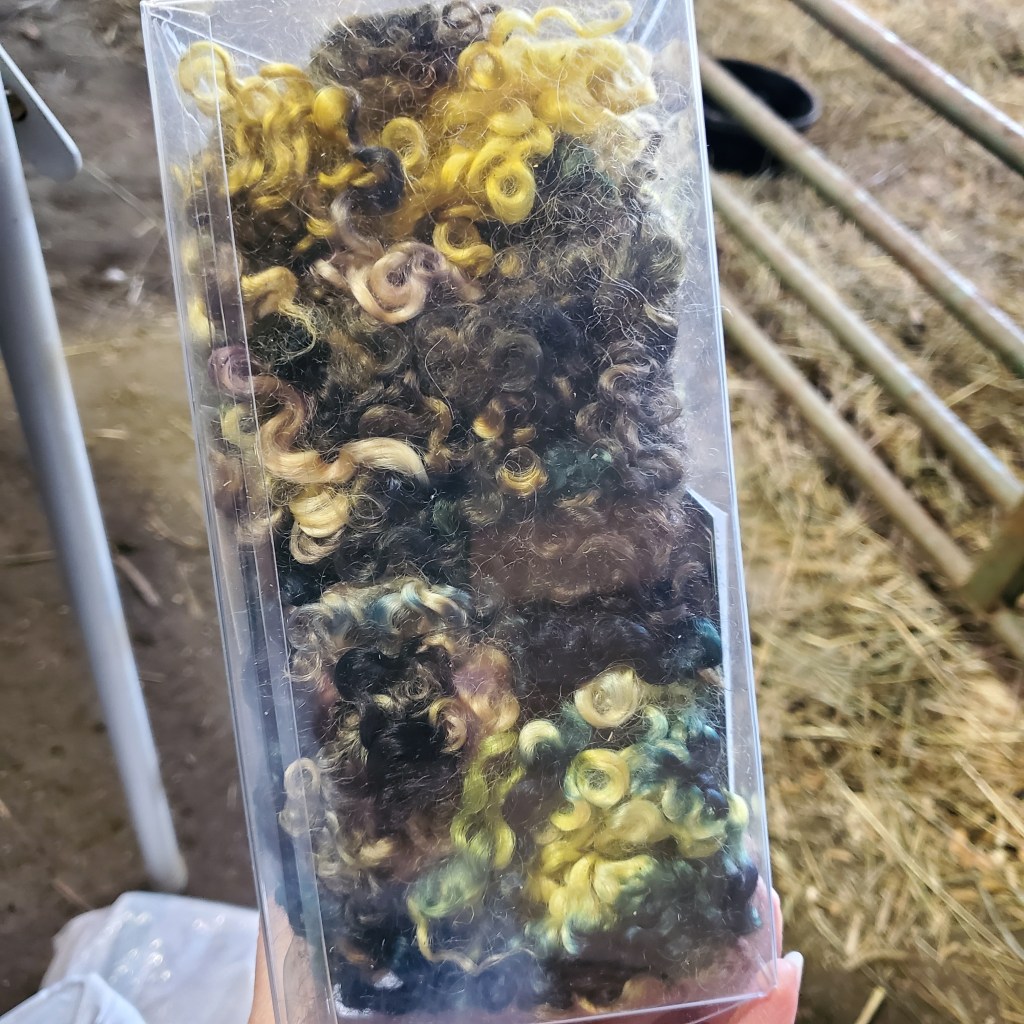
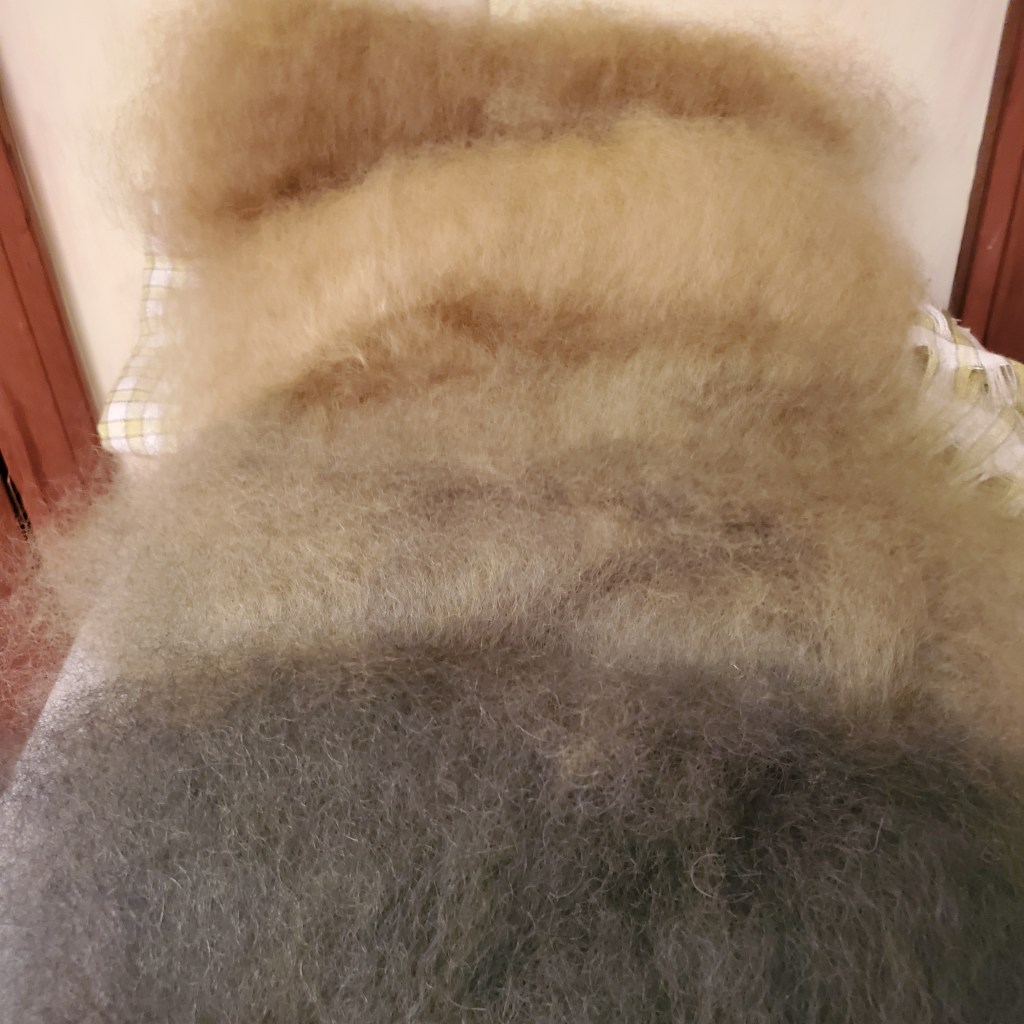
Not done yet; have mostly the darker shades to go.
Here’s a shot of some of it against the last piece of fabric I made at weaving school; I always enjoy seeing how I not-purposely make things the same or complementary colors over and over. “Well yeah, Tytania, it helps that you’re a green maniac.” Other day at the market in my green suede and green felt hat and green fancy purse someone asked, “Let me guess, your favorite color is green.”
by Michael Pollan
Amazing.
I’m not sure how to begin. Michael Pollan is about my age and a materialist – an atheist, with the perspective that the physical laws of matter should be able to explain everything there is. And yet. Those who go on psychedelic journeys so often have mystical experiences – “the conviction that some profound objective truth has been disclosed,” like they “have been let in on a deep secret of the universe, and they cannot be shaken.” William James wrote, “Dreams cannot stand this test.”
Pollan writes, “The most straightforward …is that it’s simply true: the altered state of consciousness has opened the person up to a truth that the rest of us… simply cannot see.”
Pollan then gives us a pretty long history of the research on psychedelics done in this country in the last century; and details about his experiences, which do qualify as “mystical” (a survey told him so). He trips on three different psychedelic substances: mushrooms, LSD, and “the toad,” literally toad venom. This last is the most amazing and the most difficult for him to put into words. What can definitely be said is that the effects of smoking the distilled venom of this toad kick in before the smoker even has a chance to exhale – you inhale one puff and you are transported to before the Big Bang, before there was any being at all. Pollan remarks on how often people express gratitude for “being alive” – after smoking the toad, he was on his knees with gratitude for there being “being” at all.
This actually was an interesting complement to my recent reading of LOST IN MATH by Sabine Hossenfelder. That was about the fundamental question of why we should ever expect the laws of physics to be “beautiful”, why we are bothered that quantum mechanics doesn’t seem intuitive – why should it be? There would have been no reason for our species to evolve to have a fundamental understanding of quantum mechanics or to have brains that “like” the laws of physics. Why the hubris that we should be able to know and understand everything? Maybe there are things we can’t know.
Not without physical tweaks, that is – in the form of certain pharmaceuticals, mushrooms, or toads – that change our perceptions enough for us to see something beyond what we can usually see.
Maybe there is something “beyond” after all.
The book also has a great section on how psychedelics are slowly finding their way back into medical research, and are showing promise to treat an array of disorders: addiction, depression, end-of-life anxiety. The story of the end days of the cancer patient who turned his mind around with psychedelics almost brought me to tears. The description of how psychedelics can alleviate addictions was enlightening – OK, existential dread being lifted by a mystical experience, that makes a certain kind of sense; but how and why should tripping help you quit smoking? I loved one woman’s explanation: “It put smoking in a whole new context. Smoking seemed very unimportant; it seemed kind of stupid, to be honest.”
We’ve seen such sea changes in the legalization of marijuana, in the acceptance of gay marriage – maybe we’ll live to see psychedelics taken off the list of controlled substances; maybe shrooms will start “popping up” someday in a store near you. This book made me really want to do drugs. Maybe not the toad. But some of the others, for sure.
by Lynda Gratton & Andrew Scott
Extremely repetitive. Summary: We are more and more likely each of us to live to age 100, so you’d better start saving more money; and abandon the “three phase life” thinking of school + work + career in favor of at least five phases, with more transitions. I just saved you 373 pages.
by Jia Tolentino
Collection of essays. She’s better when not talking about herself.
She’s in her 30s, Filipina, grew up in Houston in an evangelical church, and as a teenager was a cheerleader and appeared in a reality TV show. I can’t relate remotely to this person.