Book Corner


haidt

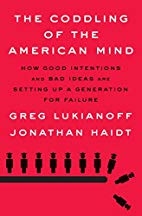
This book does not disappoint a long-time Haidt fan. His arguments continue to be exquisitely measured and explained to appeal to any reasonable person willing to listen. He does not suffer for collaborating with co-author Lukianoff, either, who seems to have the same style.
The title makes it sound like it is going to be a conservative or curmudgeonly rant – “coddle” is such a smug and “when I was your age” kind of verb. But you can trust Haidt. He’s very sympathetic, for example, to what even the most strident and intolerant protesters may be trying to achieve; he’s just pointing out, clearly and convincingly in my opinion, how they are harming their cause more than helping. That is one major area covered in the book – college protest; and although I was familiar with many of the cases described here, such as Charles Murray’s appearance in Middlebury in my home state of Vermont, I had no idea of the extent of some of the other things going on in the rest of the country, like the truly anarchic takeover of Evergreen College in Washington state. Again, don’t think this is just some conservative outrage-generating listing of cases where those liberal students went too far in their political correctness. There are some eyebrow-raising incidents described here, but the authors aren’t out simply to raise ire about them; but to explain where they feel things went wrong.

Another subject covered in the book is the overprotectiveness of parents in our modern culture, and effects of excessive screen time on kids; they authors see these as roots of the excessive fragility of the younger generation of today’s adults.
The authors hold up cognitive behavioral therapy (CBT) as a proven successful method of dealing with depression and anxiety, and use its tenets as models of how we SHOULD be raising children and encouraging young people to deal effectively with their feelings of fragility.
Major fault: I don’t understand why they felt they had to end every chapter with a summary – and then end the book with an overall summary, as well! For Pete’s sake, have a little faith that I know what I just read.
The only other fault was really just a personal disappointment that there was a lot in it about raising children, and the rest was almost all about college students – I guess if I had read the description I would have been more prepared; but I selfishly wanted more things to apply to my own life.
Book Corner

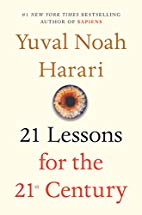
harari  21 Lessons for the 21st Century by Yuval Noah Harari

Sapiens being the best book I have read in recent memory, and Homo Deus coming close behind, this had a lot to live up to.  It had strong and weak parts.  It could get repetitive.  The structure was very good – one “lesson” leading into another, each one feeling complete and there for a reason.  When it was good, it was very good.  I have no fewer than eight little sticky notes sticking out of it pointing to excellent quotes.  Here are some:

“Panic is a form of hubris.  It comes from the smug feeling that one knows exactly where the world is heading: down.”

“We are now creating tame humans that produce enormous amounts of data and function as very efficient chips in a huge data-processing mechanism, but these data cows hardly maximize the human potential.”

“[Facebook] and the other online giants tend to view humans as audio-visual animals – a pair of eyes and a pair of ears connected to ten fingers, a screen, and a credit card.”

“We must realize that nothing the terrorists do can defeat us.  We are the only ones who can defeat ourselves, if we overreact in a misguided way to their provocations.”

“Apparently ape leaders developed the tendency to help the poor, the needy, and the fatherless millions of years before the Bible instructed ancient Israelites that they should [do the same]…”

He ends with a chapter on meditation on a slightly more personal note.  Serious talk about meditation always leaves me with three questions: What motivates Buddhists to get up in the morning?  Why shouldn’t I work with the nature of my mind rather than against it?  If many fictions are useful, why not use them?

Book Corner

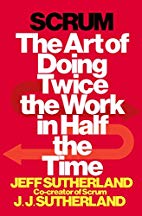
scrum.jpg  SCRUM: The Art of Doing Twice the Work in Half the Time

by Jeff & J. J. Sutherland

There are surely better SCRUM books to buy (but this one was recommended by me by my pal and co-worker James).  The author, CEO of Scrum, Inc. (it’s his story, co-authored with his son), is a bit self-congratulatory, and his cheerleading for SCRUM often comes across like he’s plugging a miracle weight loss regimen.  That said, it did get me excited about some scrummy ideas, and inspire me to try to put some into practice.  My job is allegedly going to try to tackle its next project in an “agile” manner.  Ha.  We’ll see how that goes.

Book Corner

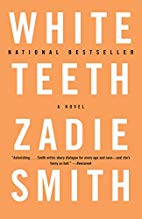
zadie  The plot twist of the ending WAS pretty good.  I was prepared to give it nothing but scathing, negative comments; but she did pull off a good ending.
But oy, so many tangents!  Too long!  “Oh, you cannot possibly understand Clara without first knowing about Ryan Topps…”  I beg to differ.  We did not need to know one whit about Ryan Topps – it would have made NO difference to the progress of the story whatsoever.
Most of the characters were at least a bit grotesque, and quite incoherent to me.  So much inexplicable conversion to religious fanaticism (Samad, Millat, Ryan Topps).  I only liked Irie, and Niece-of-Shame – I LOVED Niece-of-Shame.  And I loved Irie’s speech telling off her family at the end – I love when annoying characters get put in their place.
But everyone else?  Samad?  Was he a good sympathetic guy, or a religious fanatic – if a religious fanatic, why did he become upset when his son also because a religious fanatic?  Millat – a bad boy, yet, joins a religious cult?  Clara – a sex bomb walking down the stairs, and then all this back history about her being ugly, and then, what of her?  She had no personality.
Things started to wear thin for me with the tangent of the Chelfins, and towards the end when Irie has sex with both twins (in succession) on one night, I decided I hated it – by that time, things felt genuinely random, and I can’t abide reading something where it seems that at any moment literally anything can happen.
Thankfully, as I said, it was tied together at the end (though I hate when pregnancy is used as a tie-together part of an ending, even a small part as here); it had a real conclusion, overlaying everything prior with SOME point.  But I’ve definitely spent a better 448 pages in my life.

Book Corner

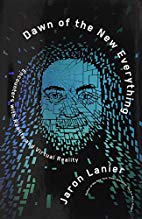
Lanier  Dawn of the New Everything: Encounters with Reality and Virtual Reality by Jaron Lanier

Although I had devoured three other of Lanier’s books, I originally wasn’t going to get this one, because I’m not terribly interested in virtual reality.  But having read a sample of the personal memoir section (it alternates between memoir and general VR discussion), I was hooked enough to make the purchase.  Lanier seems remarkably un-self-conscious about what an extraordinary upbringing he had.  As a young teen, he was allowed by his single parent father to DESIGN their house.  Which they then BUILT.  And LIVED IN – I think his father was there till his old age.  You have to see the picture and read the descriptions of this structure.  Moving on, Lanier also downplays what an extraordinary polymath he is; his young adult years are full of wonder and interest in almost everything life throws his way.  What an extraordinary individual!  Alas, I’m still not very interested in virtual reality; and he dwells an awful lot on the his company in the 80s, the people and the physical surroundings, which really don’t make as good a read as the multi-dome structure in the middle of the desert designed and built by a lunatic teenager.  The appendices trod over territory familiar to those who’ve read his other books, but serve as excellent summaries of his positions on AI and social media, which endear him to me.

I won’t try to summarize why you should delete your social media accounts right now; I’ve done so elsewhere, and it was the inspiration for me starting this paid-for blog.  But as for AI, and the singularity, and how AI is going to get smart and kill us all, I’d like to bring up an old joke: Son of Sam was crazy.  Son of Sam was crazy because he said he killed people because his dog told him to.  A sane person knows, if your dog tells you to kill people, you say: “NO!  BAD DOG!”

So, if AI programs start trying to kill us?  We say, “NO!  BAD PROGRAM!”

I think that sums up his take.