I made it to 50.
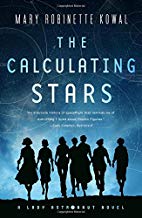
The Calculating Stars by Mary Robinette Kowal
Disappointing. It got off to such a strong start. A meteor hits in 1952 off the coast of Maryland and literally wipes out DC and much of the eastern seaboard. The heroine and her newlywed husband are in the Poconos when the blast hits, and they get themselves to safety in time to survive the aftershock. They are both scientists and can do calculations and know what to do and when to do it. They get to their private plane and the heroine pilots them to an air force base in the Midwest – the war has recently ended and they are both veterans as well as scientists.
I loved the matter-of-fact way both of them responded to the disaster and how she was every bit as calm and smart as he was. Unfortunately this was not the tone that persisted through the rest of the book. We dealt a lot on the heroine’s anxiety problems; and the husband’s perfection in the eyes of the first-person narrator, his wife, became tiresome. Of course he was always handsome and brilliant and handsome and chiseled and handsome in every situation. Their innuendo and the way they couldn’t keep their hands off each other got annoying quick.
The story certainly brought home the impact of sexism on STEM-happy females during the post-war era. I felt the situations and reactions on this front were realistic. However, the book’s forays into the similar injustices of racism were very difficult for me to accept because I couldn’t get over the not-period way that characters talked about it. People were referred to as black. I’m sorry, but the word used back then was “Negro”, or sometimes “colored.” At once point, the phrase “men and women of color” was even used by a character! I couldn’t get over this glaring error of tone, and faithlessness to the alleged period.
I got a little skimmy by the end of the book. I knew it would have a happy ending and I just wanted to get to it. (  )
)

The Problem with Everything by Meghan Daum a.k.a. My Twin
I’d read Meghan Daum’s THE UNSPEAKABLE and found I could not be impartial about it, because it was like she was talking out my own brain. I felt the same way throughout this book, except for the parts about her divorce (I am still married). So I guess I can’t be impartial about that, either, in an opposite way – because it is so NOT part of my brain. The parts about her divorce were the least interesting, and I’m just glad they weren’t dwelled on any further than they were.
Spoiler – if there’s such a thing as a spoiler for a book of personal essays – the last paragraph is the best: “The problem with everything is meant to keep us believing, despite all evidence to the contrary, in the exquisite lie of our own relevance. What a gift. What a problem to have.” Maybe it’s not much of a spoiler, because I guess you have to read the whole book to understand it.
The problem with everything that Meghan wants to complain about most in this book comes down to “toughness.” She was born in 1970, I in 1969. We grew up wanting to be tough. Adult. “Kids today,” however, almost seem like they revel in being vulnerable.
We had Zoom. We had Jodie Foster and Kristy McNichol. We had androgyny, being a kid, not a little girl. Meghan hits on an interesting idea: finding out the sex of your baby before the birth didn’t become a common thing till the 80s. Maybe, once people starting finding out the gender and preparing for it well in advance, with pink/blue parties and nurseries, this had something to do with the return of little princess girly girls. We weren’t all tomboys, but no one in my generation wanted to be a princess. (“Kids today!!”)
This plays into the main topic which is the problem with feminism (as well as everything) today. There’s no room for being “tough” anymore; it seems we are supposed to be the opposite, and raise a big complaint about everything no matter how micro.
But back to my life! The first chapter is about the woman who used to protest pornography back around 1990 in NYC, manning a table with a big poster of a woman being fed through a meat grinder. I remember that vividly, in Grand Central Station! Meghan describes her as feral, kind of insane. I agree. I was anti-pornography back then, but the one time I tried to engage her, she talked right through me.
Meghan lived my life. “To be 20 years old in 1990 was, as far as I was concerned, to own the world.” “I practically skipped to the office every morning.” Construction workers would whistle at her/me “because I was 20 years old.” She talks about re-entering the city now as a middle-aged woman. “Now that I had returned, it was as if my 20s were being handed back to me in used condition.” I feel that way on every return visit.
I just can’t be impartial about this book. Five stars for being me. I hope you continue to publish my thoughts in book form, Meghan. (  )
)

 )
)
 )
)


 )
)

 )
)
 Tytania