Book Corner 2022.42

by Margaret Hathaway

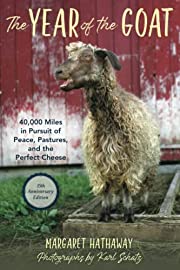
A couple decides to embark on a year of hands-on, cross-country goat research. Yes, it’s a classic “My Year Of” book – it’s been a while, hasn’t it!

Margaret and Karl decide they want to produce goat cheese. Or something. They know they like cheese and they think they like goats. So let’s do some research – and maybe get a book deal out of it. They visit a lot of farms and auctions; discover, to some relief, that yes! they like goats. And decide, definitely dairy. Not meat.

So there’s my main beef (ha ha). Despite the fact that there is a cashmere goat on the cover; “Angora goats rounded up for shearing” in the photo section plus a photo of someone’s angora goat mailbox… fiber goats practically don’t exist in this book. It’s dairy or meat with no Choice C.

My second complaint is the 30,000-foot view of everything that we get. Example: a buckling sold at auction for $16,000. The buckling is shown in the photos; and the sale is mentioned in the text. What breed of goat is he? Who knows? I guess the authors knew – this is all allegedly part of a research project with dutiful note taking. But the detail somehow missed getting into the book. Who is this book for?

I bought it and read it because I just wanted to be around goats. But I can’t give it more than two stars.

Book Corner 2022.41

by Sabine Hossenfelder

I can’t say I understood any of the physics in this. Yet I read the whole thing. (Save the appendices.) Because she keeps it so funny, and because the premise is simple: we should harbor no expectation that nature should be beautiful; and science should be about finding the truth, not coming up with beautiful theories. “We don’t seek theories to evoke emotional reactions; we seek explanations for what we observe.” Yet physicists keep working on theories where the math is ‘beautiful’, regardless whether these theories bear any relation to reality or can even hoped to be proven or disproven.

Hossenfelder is a physicist based in Germany. She literally travels the world to write this book, interviewing physicists, often wearing out her welcome, to ask each of them about their work; why do they think this is beautiful and the other unsatisfying, and above all, why do they think we should care what’s beautiful. She’s harsh in her criticism of getting “lost in math” to the detriment of what should be the main business of explaining the world. Or in her words:

“Maybe I’m just here to find an excuse for leaving academia because I’m disillusioned, unable to stay motivated through all the null results. & what an amazing excuse i have come up with – blaming a scientific community for misusing the scientific method.”

Some passages that made things simple enough for even me to understand:

“If you have a map of a mountainous landscape that doesn’t show altitudes, winding roads won’t make much sense. But if you know there are mountains, you understand why the roads curve like that – it’s the best they an do. That we cannot see the curvature of space-time is like having a map without altitude lines. If you could see space-time curvature, you would understand it makes perfect sense for planets to orbit around the Sun. It’s the best they can do.”

“It makes sense, intuitively, that our intuition fails in the quantum world. We don’t experience quantum effects in daily life… Indeed, it would be surprising if quantum physics were intuitive, because we never had a chance to get accustomed to it. Being unintuitive therefore shouldn’t be held against a theory. But like lack of aesthetic appeal, it is a hurdle to progress. & maybe, I think, this isn’t a hurdle we can overcome. Maybe we’re stuck in the foundations of physics because we’ve reached the limit of what humans can comprehend.”

Book Corner 2022.40

by Ken Kesey

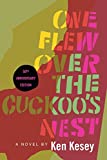
This was a hard read because it’s narrated from the point of view of one of the mental patients; namely, the Chief, the most memorable character in the movie – I came into this having seen the movie, once, about 15 years ago. I was psyched that it was told from “Chief” Bromden’s perspective at first, but it’s a little hard to go with him down so many of his schizoid journeys.

It was fun to read how Nurse Ratched and MacMurphy were originally written; and the most memorable, climactic scenes were very true to the book.

PS Extremely sexist and racist.

Book Corner 2022.39

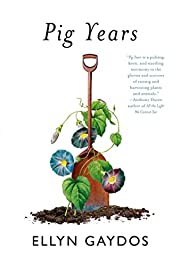
by Ellyn Gaydos

This book is about the hard work of being a farmhand, spending a day with back bent doing serious vegetable farming, and killing animals. Killing a lot of animals.

Very poetic. Was sometimes hard for me to read for an hour at a time, because of its lack of narrative arc. But beautiful in places.

“I love him too, but I am promised to farming. I choose it over him every time. It is not like choosing between two people. How could you trade the sky, the water, or the mountains for a single heart? Instead I imagine the earth opening to take me into its fold.”

“In the heart of summer, [we] are dwarfed by the farm, the sheer life force of it, pulled by the demands of plants and animals, pressed like blunt objects into the ground, buried in the work we have wrought.”

“[T]here is always enough food to eat. This is the compensation for the crude work of training life into channels of fecundity.”

Book Corner 2022.38

by Michael Schur

Michael Schur is a television comedy writer, and boy does he think he’s funny. He needs to footnote nearly every page with jokes. So, just go with the flow.

This is a fun-filled romp through ethics as philosophized through the ages. We go from Aristotle to Kant to brief divergences into the Existentialists and Ayn Rand; the utilitarians and Peter Singer; the African concept of “ubuntu”; and kind of a letdown of a final chapter on saying you’re sorry and a rambling letter to his two children.

I certainly laughed out loud several times every single reading. But I did not learn how to be perfect.

Book Corner 2022.36

by Vaclav Smil

Numbers fill almost every paragraph of this book, and it was honestly hard not to glaze over a lot. This is the fault of myself and not the book; a book like this is all about numbers, as it’s about facts, how the world “really” works, after all.

The “four pillars of modern civilization” for Smil are: cement, steel, plastics, and ammonia. Overall this book is about that material, tangible, real-world “stuff” of civilization; and Smil casts snarky asides at every opportunity towards microprocessors, smartphones, AI, and anything else that isn’t “stuff.” We need the “stuff”, continuously, and in abundance, and the non-stuff isn’t going to save us.

You might recognize cement, steel, and plastic as literal building blocks of civilization; but just in case you can’t see how ammonia fits into the top four, it’s due to importance as fertilizer. And abundant synthetic fertilizer was a crucial input to Earth’s population boom. Simply put, “nearly 4 billion people would not have been alive without synthetic ammonia.” More existentially important than silicon wafers, to be sure.

Cement? “Yet another [!] astounding statistic is that the world now consumes in one year more cement than it did during the entire first half of the 20th century.”

And as for fossil fuels, and hopes for our conversion to renewable sources of energy? “Until all energies used to extract and process these materials come from renewable conversions, modern civilization will remain fundamentally dependent on the fossil fuels used in [their] production.” It’s the oil and natural gas that get us all this steel, cement, plastic, and ammonia. Electric cars are great. But renewable electricity is not going to be able to perform the herculean job that fossil fuels do today in terms of producing the material that makes our world go round.

Smil is neither an optimist nor a pessimist, but a scientist, and it comes through. It is refreshing to read someone who neither is gung ho about how we’re gonna solve everything, nor ready to lay down and die. He thinks we’ll muddle through. But here he cuts through the “muddle” of misleading information that comes from both optimists and pessimists.

Book Corner 2022.34

by Edward Lee

Chef Edward Lee travels the country, eats food, and apparently wastes food, as the humongous amounts of food he reports ordering at restaurants cannot possibly be eaten by him. I just can’t believe he eats all that. And he doesn’t bring a traveling companion save in one chapter.

He visits New Orleans, Clarksdale, Montgomery, Indiana, and lots of other places. The chapters generally provide some introduction, some talk about the logistics of travel, interviews with chefs, and eating, and conclusion.

The most memorable was his chapter of visiting Detroit, a city with a large Muslim population, during Ramadan. He decides to try the sunup-to-sundown fasting. Yet he sticks to his plan of visiting restaurants and talking to chefs and ordering a ton of food – and photographing it and talking about it – just not eating it. I was intrigued why someone would torture himself that way. When sundown is moments away, and he orders a big meal at a restaurant that he can actually eat immediately, a fellow faster frowns at him. He tells him he should break his fast with something humble; the fast is about showing solidarity with the poor, so it would be more fitting to order something humble. Besides (here it comes) all that heavy food you just ordered would just make you sick if you ate it right away.

I wasn’t particularly grabbed by any other chapters. Lee seems likeable enough. I couldn’t help comparing it to EAT A PEACH by David Chang, another Korean chef memoirist. But unlike Chang, Lee is not into writing about his restaurants, or even himself, very much. They are very different books.

Book Corner 2022.33

by Gretchen Rubin

A sequel to THE HAPPINESS PROJECT. Gretchen Rubin once again undertakes methodical, highly planned projects, or ‘resolutions’, to increase her levels of happiness. It’s hard for me not to relate to Gretchen, even though she does have kids. She’s a redhead. She twirls her hair. “Whenever possible,” she reads while she eats. She “dislike[s] talking on the phone.” There’s all that damn methodicalness. But maybe best of all, she flat-out refuses to try meditation.

She states up front that this is going to be HER happiness project; what works for her won’t work for everyone, but there’s still value in documenting her own personal journey, which can be a template or jumping-off point for readers whose mileage varies. OK, but she still gets way too deep in the weeds occasionally. I totally skipped the email exchanges with her sister about some collaboration they were going to do – I think it was a young adult mystery book? Why do I need to read all their emails about it? Suffice to say that collaboration was a source of happiness. And this weird project of building a little diorama in their kitchen cupboard also needed editing.

I like how she handles the most common criticisms leveled at her.

  • “You really must meditate if you’re going to say anything about happiness.” Response: “Hmm.”
  • Paraphrasing here: But you can’t aim directly at happiness; you have to simply do things that will cultivate happiness as a side effect. Response: How is that different than aiming directly at it? What concrete things are you doing to cultivate happiness as a side effect? How are they different than things you’d do to try to be happy directly? This is a really good point, once you start to think about it.
  • And paraphrasing here: ugh, all those tasks you set for yourself! All those resolutions! Sounds so tiring! Happiness doesn’t come from being busy. Busyness is a distraction. Response: Works for me!

Her ultimate mantra, after all, is to be herself. Which isn’t a bad mantra. I wonder if she’s considered meditating on it.