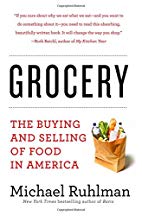
Grocery: The Buying & Selling of Food in America by Michael Ruhlman
∗∗∗∗½
A little hard to be objective – I thought all this time I was the only one! I LOVE grocery shopping! It is without exaggeration the highlight of my week. I can fathom that some people might not love it, but consider it a “chore”? Would rather sit at home and click things online and have them delivered? Just suck all the joy out of life, why don’t you!
And not only that, but Ruhlman traces his love of grocery shopping back to supermarket visits with his Dad – ME TOO! Periodic mass grocery shopping for the household was my Dad’s task, too, and I loved being his helper. He made everything a game; and it didn’t hurt that he too had a liberal hand in allowing me to toss into the cart any manner of dessert and snack items I wanted (because he loved them too). He did occasionally raise a very feeble protest against the sugary cereals me and my sibs insisted on eating – but he lost that battle one time when he brought home Whole Wheat Total and tried to claim it was “all they had.” We refused to eat it. We probably ate donuts or instant breakfast or pop-tarts instead.
But I should get back to the book. It has history, it has plenty of cultural and nutritional commentary, it has a big focus on the small Cleveland chain of grocery stores patronized by Ruhlman throughout his life, but it also has further digressions where Ruhlman channels his inner Michael Pollan to take us on in-depth exposes, interviews with experts, and adventures which reveal the underside of the simple act of grocery shopping.
I was on the edge of my seat throughout almost all of it… though I have to admit he lost me a couple of times, such as when he spent a chapter on supplements. Supplements!? Who cares! That’s not food! And likewise when he spent a chapter traipsing through the woods with some dippy guy who talked about how we absorb healing chemicals just by being present in the forest. Again… THAT’S NOT FOOD.
And I’m sorry, one more quibble. As I said, I did appreciate his talking about his experiences with his Dad. But I think that in place of the endless “My Year Of…” books we were subject to a decade ago, now we all have to deal with “Coming to Terms with the Death of My Parent When You Thought All You Were Going to Learn about was Hawks/Whales/Hiking the Pacific Crest Trail/Supermarkets.” Every non-fiction book these days seems to have to have a connection to the author’s dead mother or father. I know, it sucks to lose your parents. Lots of things remind you of them. By all means, tell me about dear old Mom/Dad. But then they always get so maudlin and overwrought about it! S/he’s dead, I know, it’s very sad. That’s exactly why you don’t have to tell me that much about it. Ever heard of “nuff said’?
So, indeed, supermarkets ARE amazing. He references a New York Times Magazine article from 1996 that I distinctly remember reading and trying to share with my friends; similar to this book, it talked at lengths about the modern miracle that is the supermarket, and engaged in some cultural commentary and comparison as the writer visited some other styles of food procurement, such as some kind of farmer’s market/open-air market in Spain, if I remember correctly… and that was cool too. Farmer’s markets are awesome too. But that doesn’t detract at all from my love of the supermarket. The friends with whom I tried to share my excitement over this article, were, I recall, definitely non-plussed, unfortunately.
Ruhlman also weighs in here and there with his opinions on best nutritional practices, which are nicely inconsistent. He has a beef against the misguided notions that eggs are bad for you and fat is bad for you (I forget which one of those gets his goat the most). He has plenty bad to say about processed food, but also doesn’t hesitate to tell us all the less-than-chef-worthy things he loved in his childhood and to which he still doesn’t seem totally averse.
My biggest takeaway was a quote from one of his interviewees, on the topic of how bad processed food is, and restaurant food is, and practically everything is, unless you bring it home and cook it yourself… bad for you inherently healthwise, and bad for you because its convenience leads you to eat too much of it. The quote was, more or less: “You want a diet? Eat anything you want – but cook it yourself.” I love it! I could eat cookies and brownies and pasta Bolognese and all my favorites, so long as I cooked them myself, which would be a joy anyway. But I’d miss my frequent restaurant meals. And occasional Chinese/Vietnamese takeout. And occasional pizza. And… so this really wouldn’t work for me.
What a joy this book was! I can hardly shut up about it. And I just ended up liking Ruhlman enough to want to read more by him – it seems he’s written a lot. I see lots of food books coming into my Kindle in the year ahead!






 Tytania