
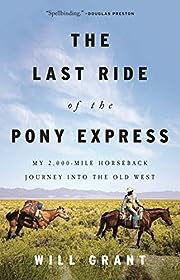
by Will Grant
This guy rode horseback across the original Pony Express Trail, maybe 2000 miles, over 142 days, with two horses, one for riding and one for carrying gear. It was amazing – and what’s truly unbelievable, the point he drove home, is that Pony Express riders used to complete the route in TEN DAYS.
The road goes from St. Joseph, MO, on the Missouri River, to Sacramento. The Midwest did not interest him. The west did. Cities gave him the heebie-jeebies; the biggest one standing in his way was Salt Lake City, and he opted to have the horses trailered around it.
He had LOTS of assistance. His girlfriend mailed him supplies. He used a smartphone. When it came time to cross the dessert, he hired someone to drop off hay and water along the route at given intervals. The desert crossing was scary to consider. There were long stretches with no water sources. If something went amiss with the hay and water dropoffs, well, I was about to say he’d be up shit’s creek, but shit’s creek would have been an improvement – at least it would have had water.
Color photos in the middle made me glad I didn’t read it on Kindle. The picture of the two horses standing utterly alone in the middle of the alkali flat in western Nevada was worth the price. One horse looks at the camera, the other “looks east from where we’d come.” I wonder what is going through that horse’s mind. Something along the lines of, “What the hell are we doing here and can we go back soon?”
They do not go back, they go forward! After the desert, which was obviously the biggest challenge, near the Nevada/California border, Grant got the heebie-jeebies again at Carson City, and just wanted the trip to be over. He did not want to subject his horses to the big city of Sacramento, he knew the hard part was over, so he had the horses trailered to the endpoint. I thought it was a fine decision.
His lesson is that the real heroes of the Pony Express were the unsung heroes: “the station keepers and stock tenders”, the people hauling water out to those waterless spots in the desert, enough to keep ten or so horses in fine condition at all times at each relay station. Astonishing. Astonishing too to think what the whole thing cost. It is very little wonder the enterprise survived for so little time. What in the world piece of mail could have been THAT important?
 Tytania